6 Setembro 2011, ODiario.info http://www.odiario.info (Portugal)
Comité Central do Partido Comunista de Israel
Este comunicado do CC do PC Israel analisa o protesto de massas que se tem verificado em Israel: não se trata de “mais um protesto”, mas de um movimento muito amplo em que convergem as camadas mais pobres da sociedade israelense, profundamente desigual e injusta. E o protesto, na apreciação do PCI, vai mais fundo: é anti-capitalista.
Uma forte onda de protesto social tem surgido em Israel. O protesto, que começou com a organização de um acampamento no Rothschild Boulevard, no centro de Tel Aviv, se espalhou pelo país desde Kiryat Shmona, no norte, até Eliat, no sul. O protesto tem sido participado por grandes e diversificados públicos – a classe média em erosão, trabalhadores com média e baixa rendas, moradores de bairros pobres, mães, estudantes – que, na maioria, trabalham para suas sobrevivências. Os líderes dos protestos são jovens, empregados e educados. Começando como um protesto contra o aumento das rendas, em uma semana se tornou um protesto contra as condições de vida sustentadas pelas políticas do governo neoliberal.
É importante entender que não se trata de “mais um protesto” ou “outra manifestação” com uma forma já conhecida em Israel, mas de um desenvolvimento político importante que requer uma análise profunda e uma rejeição do pensamento convencional.
1. Na essência, o novo movimento de protesto social é anti-capitalista: representa uma resistência às políticas dominantes do neoliberalismo de privatização e desmantelamento dos acordos de bem-estar; representa um apoio aos valores socialistas e uma crença na responsabilidade do estado para com os seus;
2. É nosso papel, no contexto do movimento de protesto, continuar a esclarecer e trazer à tona a natureza ideológica da luta básica – uma luta entre dois caminhos diferentes: um estado que é responsável por todos os seus cidadãos e residentes versus um estado que os abandona às forças do mercado e dos magnatas.
Ao mesmo tempo, devemos elucidar a natureza política da luta – e convencer o público de que Netanyahu prefere os interesses dos magnatas e das oligarquias às necessidades do grande público; ele prefere ocupações e assentamentos à vida diária da sociedade Israelense – e que qualquer mudança real requer a derrota do governo de Netanyahu.
1. O protesto anti-capitalista enfraquece, mas não erradica, as perspectivas nacionalistas e as polaridades políticas em torno da questão da ocupação em andamento dos territórios Palestinos e do acordo de paz;
2. É nosso papel, no contexto do protesto, continuar explicando, paciente e sensivelmente, a conexão entre essas duas questões. Nós temos que relembrar aos nossos ouvintes do alto custo económico e social das políticas de ocupação e assentamentos. Uma paz justa facilitará uma mudança de prioridades e mais investimento em moradias, educação, saúde e bem-estar.
Devemos continuar falando contra as tentativas do governo de erradicar os protestos através de meios que levem a outro conflito militar ou, até mesmo, guerra.
Devemos continuar falando contra as tentativas do governo de “dividir e conquistar” enquanto se aprofunda a discriminação nacionalista contra a população Árabe de Israel. O verdadeiro teste do protesto será sua habilidade de manter solidariedade e ampla unidade frente a todos que foram prejudicados pelas políticas dominantes.
1. A luta pela mudança social em Israel pode obter sucesso somente com uma luta conjunta entre Judeus e Árabes. A adopção de um modo Judaico-Árabe de acção é um teste importante para a maturidade do movimento de protesto. A organização de acampamentos de protesto nas comunidades Árabes e nas cidades, liderada por membros do PC de Israel, é um desenvolvimento importante guiado para consolidar o carácter do protesto Judaico-Árabe.
Até agora, o protesto não assumiu o carácter de uma manifestação de massa entre o público Árabe. Os mecanismos de divisão nacional que existem em Israel criam uma sensação de distância do protesto existente dentre os segmentos do público Árabe.
A população Árabe deve ter um lugar importante nesse protesto. A participação da população Árabe no protesto é importante porque seu público sofre muito mais com a falta de moradia e serviços sociais e com a pobreza dobrada, ou quadruplicada, como resultado das políticas discriminatórias de todos os governos Israelenses contra a minoria nacional. A direita tenta empurrar os cidadãos Árabes para fora do campo da actividade social e política em Israel.
1. O protesto social está se espalhando junto com as importantes lutas dos trabalhadores. Os médicos estão liderando uma luta prolongada não somente em relação às suas condições de trabalho, mas também pelo futuro do sistema público de saúde. Os professores universitários estão lutando por empregos justos. Os trabalhadores químicos de Haifa estão conduzindo uma prolongada greve e os trabalhadores das indústrias alimentícias do norte estão lutando contra demissões. De qualquer maneira, até agora os trabalhadores organizados em sindicatos não se juntaram ao protesto com força total. O líder da Federação Histadrut de Trabalhadores, Ofer Eini, está tentando diluir o protesto focando em alguns “itens de compra”, isto é, progressos limitados e localizados;
2. Na essência, o movimento de protesto social é uma progressiva manifestação de força não somente contra o actual modelo de capitalismo neoliberal, mas, também, contra as correntes fascistas que ameaçam o espaço democrático de Israel. O movimento de protesto é prova clara de que a sociedade Israelense também mantém uma quantidade não desprezível de forças saudáveis, as quais podem produzir mudanças progressivas. Essa é uma resposta formidável e convincente para os sentimentos de desespero que, nos anos recentes, tem caracterizado certos grupos na esquerda e na população Árabe.
O PCI nunca compartilhou a sensação de desespero do público Israelense e da sociedade Israelense. Nossa análise Marxista sempre nos permitiu expor a natureza dialéctica da realidade, com suas contradições inerentes e as possibilidades de mudança, que essas contradições produzem continuamente. No 25° Congresso do partido (2007), nós reiteramos nossa análise da estrutura básica da sociedade de classes Israelense. Argumentamos, incisivamente, contra todas as abordagens que subestimam o poder e a importância das contradições internas da sociedade Israelense e a condição que essas contradições têm de criar uma estrutura real de mudança.
1. Nos últimos anos o PCI tem conduzido, sistematicamente, uma forma de “políticas de massa”, dentro do público Judeu também. “Política de massa” consiste em um ponto de virada para o público com slogans que tem o poder de mobilizar. Ao mesmo tempo, continuamente constrói parcerias na luta, tais como a campanha municipal de Tel Aviv por “Uma cidade para todos”, as acções do Primeiro de Maio, as generalizadas manifestações democráticas contra os perigos fascistas, assim como nossa actividade relacionada ao estabelecimento de um estado Palestino, acabando com as ocupações e alcançando uma paz justa. “Política de massa” não significa um abandono do nosso caminho ou nossos princípios. Subjacente, essa política é a compreensão de que determinar os princípios é somente o começo da acção política e não sua nota final: que os princípios não têm força se não forem traduzidos em bandeiras que o público possa entender. Ser uma vanguarda progressista, de acordo com a formação leninista, é, de fato, caminhar antes das massas, mas numa distância que o público possa acompanhar a liderança.
2. As “políticas de massa” do PCI contribuíram, e ainda contribuem muito no desenvolvimento de uma luta progressista em Israel. De qualquer maneira, será um erro grave achar que essa luta nos fortalecerá politicamente. A história está repleta de exemplos de protesto social que não traduziram a verdadeira mudança.
A mudança acontece, somente, quando o protesto social é traduzido para a acção política e dirigido para o poder político. Para que isso aconteça em Israel, um amplo movimento socialista deve surgir do protesto social e se consolidar – um movimento que irá incluir do nosso lado, inclusive, outros grupos, organizações, movimentos da juventude e organizações sociais. Tal movimento deve integrar valores socialistas, luta democrática e deve ter um carácter Árabe-Judeu. Também deve ser baseado na apreciação da conexão entre a ocupação e os problemas da sociedade.
1. Estamos diante de um desafio urgente, nesse contexto, porque as eleições para a Federação Histadrut de Trabalhadores se aproximam. Na iminência dessas eleições, trabalharemos por uma ampla cooperação Judaico-Árabe e socialista, com o Hadash no centro e apresentando um candidato para liderar o Histadrut – como uma alternativa de esquerda à política de colaboração com o regime político e com o capital, que é o que líder do Histadrut tem feito.
2. Uma profunda análise da luta social e das oportunidades que ela nos abre para mudar a sociedade Israelense vai ficar no centro da nossa preparação para o 26° Congresso do PCI, que ocorrerá no final do ano.
Paralelamente, disponibilizaremos nossas mensagens de consciência de classe na imprensa do partido, no nosso trabalho político no Knesset, nos conselhos locais, no Histadrut (Federação de Trabalhadores em Israel), federação Na’amat de mulheres, sindicatos de professores, conselhos de trabalhadores e na nossa actividade entre as mulheres, os estudantes e a juventude.
O Comité Central do PCI saúda os membros do partido que estão activos no movimento de protesto social.
O Comité Central do PCI chama todas as organizações partidárias e Juventudes Comunistas, e nossos parceiros no Hadash, para continuar a organização de acampamentos nas comunidades e na vizinhança e para consolidar planos práticos de trabalho em cada respectiva área de actividade, no espírito dessas decisões.
Agosto de 2011
Website do Partido Comunista de Israel (em Inglês):
http://maki.org.il/en/index.php
Traduzido por Mariângela Marques.
Mostrando postagens com marcador Histadrut. Mostrar todas as postagens
Mostrando postagens com marcador Histadrut. Mostrar todas as postagens
quinta-feira, 8 de setembro de 2011


domingo, 7 de agosto de 2011
Activists' demands to Israeli government: lower taxes, free education and end to privatization
3 August 2011, Communist Party of Israel המפלגה הקומוניסטית הישראלית http://maki.org.il
After setting up joint protest headquarters on Tuesday, representatives of the 40 tent encampments scattered across Israel, students and youth groups released an agreement they had reached and guidelines for negotiating with the government. Also: protests continue across the country with activists blocking roads.
The demands include lowering indirect taxes, canceling the national housing committees bill, free education starting at the age of three months and increasing the Housing Ministry's assistance budget to mortgages and rent.
The activists also demand steps be taken in the health care system, such as more positions for medical staff, more beds, medical equipment that upholds the standards for OECD countries, an end to the privatization of welfare institutions and mental health centers and a commitment to a gradual cancellation of contractual work in the public center.
Following is a list of partial demands included in the "Guidelines for a new social-economical order" document:
• Reducing indirect taxes
• Investing tax collection surpluses in citizens via state budget
• Canceling the national housing committees bill
• Increasing the Construction and Housing Ministry's budget on mortgages and rent, and increasing government aid
• Applying the Free Compulsory Education law to kids from age of three months
• Adding job posts, beds, medical equipment and infrastructures nationwide to match the OECD standard
• Halting privatization of welfare and mental health institutes
• Gradual cancellation of contractual work in the public sector
The National Union of Israeli Students stressed that the list constitutes an agenda for the negotiations, therefore there is no mention of numbers and costs. However, during the meeting in Tel Aviv the organizers said that a final document is being drafted, one that will include clauses and numbers.
Meanwhile, approximately 150 people gathered on Tuesday evening at Bilu Junction near Rehovot to protest the high costs of raising a family in Israel, occasionally blocking the junctions. In Hod Hasharon about a hundred fathers, mothers and children took part in a "stroller march." Around 200 demonstrators marched yesterday night in Tel Aviv's southern neighborhoods as a token of support with the housing crisis protest. Among them: representatives from Israel's many basketball and soccer teams. The demonstrators held signs with slogans calling for social justice and against the government.
Hundreds demonstrated outside of the Knesset on Tuesday evening against the discussion Wednesday of Prime Minister Binyamin Netanyahu's new housing law, which they claim does not have enough provisions for public housing and ensuring that the new housing will be affordable instead of luxury housing. Chanting "The people wants social justice!" hundreds from the Jerusalem tent city in Gan Hasus (Horse Park) marched to the Wohl Rose Park, where they were joined by buses of protesters from as far away as Kiryat Shmona, on the Lebanese border.
Today (Wednesday) morning, hundreds of affordable housing protest activists rallied outside the Knesset Wednesday ahead of a planned vote on Prime Minister national housing committees' bill. The affordable housing movement has vowed to escalate its protest measures should the bill, which they have slammed as manipulative mature into a law. Protesters block all of the entrances to the Knesset building in an attempt to stop the Parliament from voting on the bill, saying they will siege the Knesset if they have to.
The Histadrut (Federattion of Labor in Israel) on Tuesday announced that it will convene tomorrow a mass assembly in Tel-Aviv to support people protesting against the high cost of living in the country. Dozens of unions and twenty thousands of people are expected to gather in front of the Histadrut building in Arlozoroff Street where a rally expressing solidarity with the protesters will be held. Histradrut Chairman Ofer Eini on Sunday met with organizers of the protests in efforts to further consolidate their demands.
In an interview with Israel Army Radio, Secretary General Eini, acknowledged that the union does not lead this social struggle, but stated outright that if the purpose of protesters is to overthrow the Netanyahu government, "the Histradut would not participate". Hadash fraction in the Histadrut demand for general strike in solidarity with the working-class and popular protest an against the neo-liberal government.
At the same time of the Histadrut assembly, they will be three large demonstrations in Tel-Aviv, Jerusalem and Be'er Sheva by junior staff lecturers in the universities and school teachers, for public education and against privatization.
sexta-feira, 5 de agosto de 2011
FROM PROTEST TO POWER
The young demonstrators would do well to remember May 1968 in Europe; a protest that does not find immediate political expression is destined to disintegrate.
5 August 2011, Tikkun תיקון http://www.tikkun.org (USA)
By Zeev Sternhell
In these times of hope and anticipation, it is difficult not to wonder what form the protest might have taken, and what results it might already have achieved, if there had been a large and authentic social-democratic party here with a labor union worthy of the name, at its side. Indeed a spontaneous uprising that does not find political expression very soon, and does not threaten those who are in power, will of necessity have very limited achievements.
Even Prime Minister Benjamin Netanyahu understands that when there is no opposition with an ideology of structural social change, and which is capable of garnering electoral support for a comprehensive national economic program, the danger facing him and his party is negligible. The truth is that the protesters themselves have already presented him with a way out. His representatives will anoint the protest leaders with pure oil, will set up teams and present ideas, will throw them a few bones and then will move to the area where there is no greater expert than Netanyahu: drawing out time and making promises that no one intends to keep.
The real problem, however, is not the government but rather the political elite. Except for a small number of politicians on the center-left, like Knesset member Shelly Yachimovich (Labor ), most of the political leadership is partner to the blind belief in the unique qualities of a free market. There were indeed people outside the political arena who for decades contended that a free market creates no less poverty and misery than wealth and welfare; there were those who believed that poverty is not some kind of natural phenomenon but rather something created by man. But all of them were considered "populist." There were people who saw in the state a tool for correcting distortions and supplying cheap and good-quality services to the entire population, but they were denounced as wanting to return to the 1950s.
Therefore the young demonstrators would do well to remember May 1968 in Europe. Beyond the obvious differences, there is a common denominator: a protest that does not find immediate political expression is destined to disintegrate.
New forces that were not involved in politics until now could play a key role. They could break the neoliberal consensus and to be the motivating force behind the creation of a broad opposition front that brings together all those who recognize the need to address the chronic ills of Israeli society - and not just deal with the milk cartels.
A front of that kind would have place for all those who shy away from the neoconservative "economy of compassion" which is the basis of the impure alliance between the government, the Histadrut labor federation and the people with big money.
Indeed a protest against the obstructed social horizon of the middle class is not out of touch with numerous other problems. In order to create a society that is more egalitarian and just a change is needed in the political balance of power. The protesters will be able to achieve substantive results only by linking up with all the forces that are opposed to the present government, but not to the settlers who are its pillars of support. It will not be enough to demonstrate and march, especially since the marchers will tire a long time before the politicians and before the Yesha Council of settlements.
Therefore, after their preliminary success, they will have to begin the process of dull political work and building up a force that can compete in the next elections. The tent dwellers may be able to provide part of the leadership and to refresh the lines. The hope that was born in the Rothschild tent city must not be allowed to expire in the argument over VAT accounts. Unless an ideological and moral force arises that can be an alternative to the destructiveness of neo-liberalism, the life expectancy of this welcome protest will be as long as the length of the Israeli summer.
quinta-feira, 4 de agosto de 2011
'A NOITE EM QUE TIVE ORGULHO DE SER ISRAELENSE'
1 agosto 2011, Carta Maior http://www.cartamaior.com.br (Brasil)
Fonte: Haaretz הארץ (Israel)
Nunca houve uma manifestação como essa antes em Israel – todo mundo junto, jovens e velhos, direita e esquerda, árabes e judeus. Esqueçam o protesto sobre moradia, não se trata mais somente disso. Aqueles que temiam que os protestos fossem muito restritos, comezinhos, ontem assistiram à sua expansão. Seus objetivos já ultrapassaram o aluguel de um pequeno apartamento. Na noite de sábado, Benjamin Netanyahu recebeu sua carta de demissão, quando dezenas de milhares de israelenses ao longo do país gritaram “Bibi, vá para casa”. O artigo é de Gideon Levy.
Gideon Levy
Foi a noite em que Benjamin Netanyahu foi expulso do gabinete de Primeiro Ministro em desonra.
Netanyahu permanecerá no gabinete por um tempo, mas esse tempo está aí. Acabou. Ele vai se contorcer e fazer promessas, dar declarações e virar as costas, ele vai pregar mais algumas peças, mas isso não vai ajudá-lo nem um pouco.
Assim como o foi ontem, ele é um pato manco. Na noite de sábado, o 17° primeiro ministro de Israel recebeu sua carta de demissão. Quando dezenas de milhares de israelenses ao longo do país gritaram “Bibi, vá para casa”, Bibi irá de fato para casa. Bye bye, Bibi, adeus para sempre.
Essa foi a noite de que todo israelense pode se sentir orgulhoso de ser israelense, como nunca antes o foi. A verdadeira marcha do orgulho de Israel ocorreu ontem. Não pode haver melhor campanha de relações públicas para um país desprezado e evitado, do que a manifestação de ontem à noite, deste novo Israel. O ministro do Exterior deveria transmitir as imagens para o mundo todo: a democracia de Israel celebrada sábado à noite, como não o era em anos, levantando-se contra todos os que a queriam morta. Sem violência, sem apoios políticos supérfluos, nem Cairo, nem mesmo Atenas, mas algo muito mais bonito – uma luz genuína para as nações.
O povo, digamos, falou com uma voz alta; sem medo e sem causar medo – Tahrir, liberdade, mas não tiroteio. Falar? Não, gritar. Sim, na noite passada eu estava muito orgulhoso de ser um israelense. Só me senti embaraçado diante de minha inabilidade em assobiar com dois dedos, como a massa que marchava pela rua Ibn Gvirol assobiava, em deboche, num volume de doer os ouvidos, ecoando pelos muros do [restaurante] Goocha, para onde os clientes tinham ido comer frutos do mar como se nada fora do comum estivesse se passando. Se soubesse, eu também teria assobiado.
Nunca houve uma manifestação como essa antes em Israel – todo mundo junto, jovens e velhos, direita e esquerda, árabes e judeus. O estado que foi criado no (velho) Museu de Tel Aviv demonstrou na noite passada sua robusteza e maturidade diante do atual Museu de Arte de Tel Aviv.
Entre esses museus repousam 63 anos de altos e baixos. A noite passada foi a mais alta marca d’água recente. Foi também, aparentemente, a maior demonstração da história, a maior depois da de Sabra e Shatila.
Os manifestantes mandaram ver ontem à noite. Palavras de ordem contra os altos preços dos alugueis eram raras. “O povo quer justiça social” era a mais comum, seguida por “Hoo, há, mi zeh ba”? Medinat harevaha (“O que é isso que vem aí? É o Estado de Bem Estar Social”). Socialismo, hoje? Sim, com a garganta engasgada e tons emocionais. O protesto ganhou asas ontem à noite. Esqueçam o protesto sobre moradia, não se trata mais somente disso. Aqueles que temiam que os protestos fossem muito restritos, comezinhos, ontem assistiram à sua expansão. Seus objetivos já ultrapassaram o aluguel de um pequeno apartamento.
Aqueles que fizeram caretas para o mini-Woodstock no Boulevard Rothschild devem reconhecer, agora, que o que ocorreu nesse boulevard é apenas o ponto de partida para a explosão de um movimento, o mais impressionante movimento da história de Israel.
Os cínicos deveriam ter vergonha de si mesmos. Qualquer um que estivesse nas ruas na noite passada só poderia se comover – e, se não, então deveria ter vergonha. Quando pisei no pé de um inocente transeunte, um homem religioso, ele encrespou: “Isso não é justiça social”. Alguém tinha ouvido essa expressão antes de tudo isso começar?
A trilha sonora da semana passada incluiu John Lennon, mas na noite passada Janis Joplin foi acrescentada – outra maneira de tornar tudo mais legal. Corinne Alal’s “Zan Nadir” também tocou na noite passada. “Estamos com medo de nossa própria sombra, presos dentre os muros dos edifícios, e a maior parte do tempo com vergonha de nossos corpos, espremidos em abrigos antiaéreos... Somos espécies raras, um pássaro estranho, sonhos no ar e cabeça no chão”. Na noite passada, os sonhos estavam no ar, e que ar! Na noite passada eu tive muito orgulho de ser um israelense.
Tradução: Katarina Peixoto
Parents and children protest in 'stroller marches' across Israel
4 August 2011, Haaretz הארץ (Israel)
By Ilan Lior and Ravital Hovel
More than 1,000 parents participated Thursday in stroller marches across Israel, with about 500 in Tel Aviv, 400 in Hertzliya, 200 in Kiryat Motzkin, near Haifa, and about 50 in Sderot, all protesting against the high cost of raising children in Israel.
Meanwhile, a protest took place outside the Histadrut headquarters in Tel Aviv, where Histadrut Labor Federation Chairman Ofer Eini and the head of the workers' committee presented speeches to demonstrators. Youth groups, together with representatives of the National Union of Israeli Students, also participated in the rally.
Elsewhere in Tel Aviv, about 1,500 university lecturers, students, teachers and youth group leaders marched on Rothschild Boulevard. They made their way to the house of Education Minister Gideon Sa'ar, calling out, "Free education for all."
The Tel Aviv stroller march headed to Gan Meir, where marchers were set to hold a rally. Despite the turnout of about 500 parents and children, this number did not meet the expectations of the protest's organizers, who predicted thousands would attend.
Yael Barda, one of the stroller march's organizers rejected claims by Eini and members of the Treasury, in which they said the demand for free education for children aged 10 and over is unreasonable. "We suggest the Treasury sits back down in front of their laptops and recalculates, because we aren't going anywhere," she said.
Barda called upon the protesters to continue taking to the streets and demonstrating against the cost of living in Israel. "We've held back for a long time with all the cynicism we have for Treasury clerks and the Israeli government. They have buried all the social laws over the last 20 years. We are not cynical. We have dreams and we are going to change this country," she said.
At the stroller marches, parents called out "The people demand social justice," "Let's show the government just who's dragging the trolley," and "We won't give up, reduce the prices."
Hundreds of parents and children also began marching from Hatotach Square in Kiryat Motszkin, near Haifa, and blocked the road, with police permission.
Israelis take tent protest to the White House
Israel's housing reform law explained
quarta-feira, 3 de agosto de 2011
ISRAELI PROTEST MOVEMENT SPARKS MASS STRIKES
3 August 2011, World Socialist Web Site http://www.wsws.org (Australia)
By Jean Shaoul
More than 100,000 Israeli municipal workers took action on Monday in a show of solidarity with the nationwide tent city protests against the exorbitant cost of housing. Local government offices were closed, streets were not cleaned and garbage was not collected.
The Union of Local Authorities in Israel and Histadrut, the general federation of trade unions, called off strikes earlier this year. This time they backed the protest in order to take control and stifle it. The Tel Aviv Municipality implemented a partial strike, opening its offices after 10 a.m., while Jerusalem did not join the strike to “avoid hurting the residents”.
In Tel Aviv and Jerusalem, teachers and supporters demonstrated, calling for better public education and a halt to a privatisation drive that has led to soaring costs and huge inequalities in access to decent schooling. They carried placards saying, “There’s private education, no social justice”.
Another protest over education costs is planned for Thursday.
Doctors have set up a tent camp outside the Prime Minister’s Office in Jerusalem and called on Prime Minister Binyamin Netanyahu to intervene to resolve the months-long dispute between the doctors and the government.
The Nurses’ Union has announced that it will join the doctors’ struggle and is planning joint protests. Nurses walked out of four wards in the Sheba Medical Centre, Israel’s largest and richest hospital, for two hours in protest against management’s failure to employ sufficient nurses in the overflowing internal wards. “Why should tourists who come for medical treatment receive better treatment than the elderly Israeli patients on respirators”? asked Ilana Cohen, the Nurses’ Union chair. “Not hiring sufficient nurses is criminal negligence”.
In Tel Aviv, dozens of students took part in a march from the tent city on Rothschild Boulevard to government buildings, carrying bundles of hay on their backs. They cried out, “Bibi [Netanyahu] it’s over, my back is broken”.
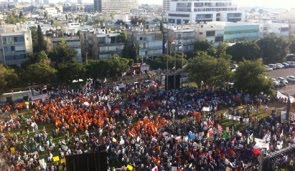
The strikes follow the 150,000-strong demonstrations, the largest in years, last Saturday to protest the soaring cost of living. The largest rally was in Tel Aviv, but others took place in Jerusalem, Be’er Sheva, Haifa and seven other cities, including Nazareth, where Arab and Jewish workers marched together.
What started as a protest of the cost of housing has spread to undisguised anger at the dozen-or-so billionaire families that control much of Israel’s economy—including real estate, communications, journalism, retail, manufacturing, construction, banking, pension savings and energy. There were calls to halt the programme of “free market” reforms and the cuts to social budgets in health and education.
While the social budgets have been cut in Israel, this is not the case in the West Bank, East Jerusalem and the Golan Heights, where residential construction is more than double that of Israel. As Globes, Israel’s business magazine points out, the higher construction and higher government spending on civilian public services was used to encourage Israelis to move to the Occupied Territories. It cited an OECD report that said that the number of Israelis living in the territories nearly doubled between 1997 and 2009.
As the protests have grown in size and support, they have created a major political crisis for the Netanyahu coalition government, the most right-wing in Israel’s history.
Netanyahu tried to defuse the protests with an announcement that a “special team” of ministers and experts would listen to the protest leaders and submit a plan to “alleviate Israelis’ economic burden”. He announced some minor policy changes and made vague promises of “reform”. These included the promise to build 50,000 housing units within 18 months, lower the excise tax on petrol for one month, double the home heating grant for some elderly people, and review taxes and water charges.
Netanyahu made clear that there will be no serious concessions to the social demands of the protesting workers and youth. Speaking at a special Knesset session to commemorate 71 years since the death of Zionist right-wing leader Ze’ev Jabotinsky, he insisted that there was no going back on Israel’s free-market economy.
Even his limited concessions have sparked fierce divisions within the government and the treasury. The director general of Israel’s finance ministry, Haim Shani, resigned citing “differences of opinion in fundamental issues” with the finance minister, adding that “events of the past few days have exacerbated the problems”.
Netanyahu is to replace Shani with Moshe Terry, the former chairman of the Israel Securities Authority. Terry has close links with Yitzhak Tshuva, the head of the Delek Group, one of the monopolies that are the focus of public anger.
Stanley Fischer, the governor of the Bank of Israel, expressed his surprise that Israelis had been protesting, as he believed “the economy is doing well”. He claimed that there were no magic wands to solve the high cost of living.
Protest leaders are demanding lower housing costs, lower taxes, an increase in the minimum wage to 50 percent of the average wage, free education and smaller class sizes, improved medical care, enforcement of labour laws, and similar measures. But Netanyahu has refused to meet the leaders of the tent protests. Instead he plans to pass them on to the team of ministers. While earlier, they had demanded that all discussions with Netanyahu and government representatives should be public in front of TV cameras, this has been abandoned under pressure from Ofer Eini, the Histadrut secretary general.
Eini, who made clear that the union bureaucracy opposes the protests, declared, “I will not support a movement which aims to humiliate a democratically elected prime minister and bring about his downfall. We are not in Egypt or Syria”.
Two years ago, Eini formed a political alliance with the former army chief of staff, Gaby Ashkenazi, to defend the military budget at the expense of social spending. As recent cables published by WikiLeaks show, he considers himself a key prop of Netanyahu’s right-wing coalition and supports its policies.
According to a May 6, 2009 cable, Eini met with US diplomats to assure them that his approval of the Israeli budget was a “kosher seal” that would guarantee Netanyahu the support of the Labor Party. He also demanded that Netanyahu personally negotiate with him over the budget, refusing to speak to Finance Minister Yuval Steinitz.
US diplomats concluded: “Eini, whose efforts were pivotal in bringing Labor into the government, views himself as a key power broker.”
The Histadrut trade union federation is under enormous pressure from the working class. But its aim in calling strikes remains the same: to dissipate anger while opposing a decisive political and social challenge to the government.
For its part, there is a growing danger that the Netanyahu government will resort to its usual tactic of launching a provocation against the Palestinian people or neighbouring Arab states as a diversion from the growing social unrest.
Early on Monday morning, Israeli forces killed two Palestinians in Kalandia refugee camp in the West Bank, after raiding several houses after a minor scuffle with stone-throwing Palestinians. Kalandia is policed by Palestinian Authority forces, but the Israeli military claims the right to enter it at night. A military commander complained that the Palestinian Authority forces were arresting fewer suspects because of the unity agreement between the Palestinian Authority and Hamas.
This follows a raid last week on a well-known theatre in Jenin, when Israeli forces arrested two people. Two weeks ago, they killed a 21-year-old Palestinian man in a raid on a refugee camp near the city of Nablus.
On Monday there was a brief exchange of fire between Lebanese and Israeli forces, when Lebanese soldiers opened fire after an Israeli patrol crossed the border.
Shaul Mofaz, a former Israeli Defence Force chief and legislator from the Kadima party, said that it was highly likely the military would mobilize reservists in September, in anticipation of Palestinian unrest ahead of the Palestinian Authority’s bid for statehood in the United Nations General Assembly. He told Army Radio, “September can potentially turn into a violent, painful event, with unclear results”.
quarta-feira, 27 de julho de 2011
Histadrut joins housing struggle as activists step up protests in Jerusalem, Tel Aviv

Some 200 protesters march toward Netanyahu's residence in Jerusalem, some 300 Tel Aviv protesters march to second tent site in southern part of the city; Histadrut chairman meets with organizers of tent protest.
27 July 2011,Haaretz הארץ (Israel)
By Ilan Lior and Nir Hasson
Histadrut Labor Federation Chairman Ofer Eini met with leaders of Israel's housing protests in Tel Aviv on Wednesday, to tell them that the Histadrut will be joining their struggle starting Sunday and intends on taking part in the protesters' discussions with the government.
The meeting came several hours after Eini issued an ultimatum to Prime Minister Benjamin Netanyahu, saying that the Histadrut would take all possible measures to help the housing struggle unless Netanyahu invites Eini and other officials to a meeting to provide solutions for the troubles of Israel's lower and middle classes by Saturday night.
Earlier on Wednesday, the Union of Local Authorities in Israel announced that it will join the housing shortage protest and declared a general strike for August 1.
Meanwhile, some 200 housing protesters in Jerusalem marched Wednesday from their tent site in the center of the city toward Netanyahu's residence, blocking major roads on their way.
Once the protesters reached Netanyahu's residence, they hung a "For Sale" sign on it, protesting that the Netanyahu family currently holds three homes.
Moreover, some 300 protesters from the Tel Aviv protest on Rothschild Boulevard marched Wednesday toward the second Tel Aviv tent site in the southern part of the city near Levinsky Street.
Earlier Wednesday, Eini opened the press conference by saying that housing prices were just part of the overall social problem facing Israel today, and just one cause of the erosion of the middle class and weaker sectors of society.
Eini said he approached all the relevant authorities in attempt to find a solution.
"Over the last month, I have met with the Finance Minister and the Industry, Trade and Labor Minister and I said, 'Let's get together.' We also made a written request to find a solution, and unfortunately we did not get a response. The protest got underway," he said.
"In the media the recent protest has been referred to as the 'housing protest'," Eini continued. "The housing prices are high, as are rental prices, but the problem is not only the cost of housing. The problem lies with the middle class and weaker sectors of society. If once I was able to go to the supermarket and make a NIS 700 purchase, today I pay double. And that is not linked to the CPI. If the CPI rises 3%, the supermarket prices rise 30%. The one benefiting from these rising prices is the government."
•Ultimatum to Netanyahu: Solve housing crisis or face full force of the unions
terça-feira, 26 de julho de 2011
Mass protests all over Israel - Poll: 87% support housing price protests
26 July 2011, Communist Party of Israel המפלגה הקומוניסטית הישראלית http://maki.org.il
Hundreds activists protesting high housing prices marched yesterday (Monday night) to Prime Minister Benjamin Netanyahu's residence in Jerusalem, and several dozen protesters then proceeded to block Gaza road across from Netanyahu's residence.
 Blocking Azrieli Junction in Tel Aviv, yesterday (Monday) night (Photo: Activestills)
Housing protests have gained momentum in several cities across Israel, and activists from the Tel Aviv protest joined the Jerusalem protesters in marching to the Prime Minister's Residence while shouting slogans such as "Welfare State Now", "Bibi (Benjamin Netanyahu) degage!" and "We Want Social Justice, Not Charity." In Tel Aviv, protestors blocked a road adjacent to the Azrieli Towers and chanted, "Netanyahu wake up – the public is worth more." Tents were set up in the junction. One demonstrator said: "We are sorry we are forced to block roads and disrupt routine but there is no more normal behavior in Israel. I don't believe the prime minister."
Some 500 people protesting against the housing crisis marched from the Tel Aviv's tent city on Rothschild Avenue to the Cinematheque, where they joined a rally held by medical interns. The protesters chanted "the people demand social justice," among other slogans. Hundreds of medical interns and doctors rallied in front of the Tel Aviv Cinematheque in protest against the Finance Ministry.
Moreover, hundreds of students and residents in Be'er Sheva were marching in protest of high housing prices, and residents of unrecognized Arab-Bedouin villages in the Negev also joined the demonstration.
Earlier Monday, Netanyahu decided to cancel his scheduled visit to Poland this week. Netanyahu's cancellation was likely caused as a result of the rising housing crisis in Israel and the mass protests that have sprouted in various cities. Netanyahu most probably feared that his trip abroad would have amplified the public protest, in which demonstrators have largely blamed Netanyahu and Finance Minister Yuval Steinitz. Yesterday hundreds of activists blocked major roads in Haifa, Jerusalem and Be’er Sheva as part of the housing crisis protests. In central Haifa, scuffles broke out between activists and drivers who were forced to stop. Eight activists were arrested in Paris Square in Jerusalem after refusing to clear the road. Dozens of activists also blocked a road at the entrance to the Knesset. Five were arrested and one police officer was injured.
General Strike
Meanwhile, a new Facebook protest page went up Monday calling for a general strike on August 1. So far more than 10,000 people said they will participate. The page was created by social activist Zvika Bessor, a 36-year-old Givatayim resident and father of a one-year-old baby. He wrote that he bought an apartment "with a crazy 30-year mortgage," and explained why he decided to go on strike: "I am sick of it. I can't keep going to work every day as if nothing is happening, pretending that if I work hard enough I'll be able to provide a decent life for my family and myself." The Hadash fraction in the Histadrut (Israeli Federation of Labor) demands a general strike in solidarity with protesters
Another Facebook protest page created Monday called for a "tent city strollers march." The organizers called on fathers, mothers and single parents to march in central Tel Aviv on Thursday with their children and strollers.
On Saturday, tens of thousands of people marched in downtown Tel Aviv to protest rising housing prices, the first major demonstration in a movement calling attention to Israel's soaring cost of living.
Dozens set up a small-scale tent city protest in south Tel Aviv’s Lewinsky Park on Monday, less than a day after municipal workers expelled a similar protest at the same spot. Demonstrators began arriving at the park at 7 p.m., and eventually faced off with a single clerk from the municipality who repeatedly warned them that if they pitched any tents they would be confiscated. Chanting “South Tel Aviv wants social justice,” protestors took turns making remarks into a single megaphone, while a few children of African migrants helped paint and color protest signs.
Aharon Madu'el, a city council member from the Ir LeKulanu (City for All) faction, said, “Of course we see the discrimination here very clearly. [Tel Aviv Mayor Ron Huldai] lets it take place on Rothschild but not down here, we’re not sure why, but we see it as a clear form of discrimination.” Speaking to the crowd later in the evening, Madu'el, a resident of south Tel Aviv’s Kfar Shalem neighborhood said, “here are the single mothers, the drug addicts, the Sudanese [refugees] who sleep here in the day and night on the benches and the stairwells, Huldai knows that a tent protest here is a legitimate protest ... I call on all of you not to give up, even if the police come to break up the tent city, we will win eventually.”
Haaretz poll shows 87% of Israelis support housing price protests
More than half the population is unhappy with Prime Minister Benjamin Netanyahu's handling of the tent protest, according to a Haaretz poll conducted yesterday. The poll also shows that an overwhelming majority of the public supports the protest and believes it stems from real distress.
Asked whether the tent protest stemmed from real distress or was a political protest against the government, 81 percent of the respondent replied that it stems from real distress, while 87 percent said they supported the protest. Only 9 percent of those interviewed said they did not support the protest and 4 percent had no opinion.
More than half the respondents, 54 percent, said they were not satisfied with the way in which Netanyahu was handling the crisis; 32 percent expressed satisfaction with the prime minister's performance, and 14 percent did not have an opinion either way. According to the poll, 54 percent of the public is unhappy with Finance
Yuval Steinitz's performance, while only 22 percent were satisfied with his work; 24 percent had no opinion.
Some 55 percent of the respondents believe the tent protest will lead to a reduction in housing prices, compared to 31 percent who predicted it would not bring about any change; 14 percent failed to express an opinion on the subject.
Also in the poll, a sweeping majority - 85 percent of the public - supports the doctors' struggle to improve their conditions, while only 9 percent do not support the struggle and 6 percent have no opinion.
Photos: http://www.flickr.com/photos/activestills/
Related Housing crisis: Protestors block entrance to Knesset
Hundreds activists protesting high housing prices marched yesterday (Monday night) to Prime Minister Benjamin Netanyahu's residence in Jerusalem, and several dozen protesters then proceeded to block Gaza road across from Netanyahu's residence.

Housing protests have gained momentum in several cities across Israel, and activists from the Tel Aviv protest joined the Jerusalem protesters in marching to the Prime Minister's Residence while shouting slogans such as "Welfare State Now", "Bibi (Benjamin Netanyahu) degage!" and "We Want Social Justice, Not Charity." In Tel Aviv, protestors blocked a road adjacent to the Azrieli Towers and chanted, "Netanyahu wake up – the public is worth more." Tents were set up in the junction. One demonstrator said: "We are sorry we are forced to block roads and disrupt routine but there is no more normal behavior in Israel. I don't believe the prime minister."
Some 500 people protesting against the housing crisis marched from the Tel Aviv's tent city on Rothschild Avenue to the Cinematheque, where they joined a rally held by medical interns. The protesters chanted "the people demand social justice," among other slogans. Hundreds of medical interns and doctors rallied in front of the Tel Aviv Cinematheque in protest against the Finance Ministry.
Moreover, hundreds of students and residents in Be'er Sheva were marching in protest of high housing prices, and residents of unrecognized Arab-Bedouin villages in the Negev also joined the demonstration.
Earlier Monday, Netanyahu decided to cancel his scheduled visit to Poland this week. Netanyahu's cancellation was likely caused as a result of the rising housing crisis in Israel and the mass protests that have sprouted in various cities. Netanyahu most probably feared that his trip abroad would have amplified the public protest, in which demonstrators have largely blamed Netanyahu and Finance Minister Yuval Steinitz. Yesterday hundreds of activists blocked major roads in Haifa, Jerusalem and Be’er Sheva as part of the housing crisis protests. In central Haifa, scuffles broke out between activists and drivers who were forced to stop. Eight activists were arrested in Paris Square in Jerusalem after refusing to clear the road. Dozens of activists also blocked a road at the entrance to the Knesset. Five were arrested and one police officer was injured.
General Strike
Meanwhile, a new Facebook protest page went up Monday calling for a general strike on August 1. So far more than 10,000 people said they will participate. The page was created by social activist Zvika Bessor, a 36-year-old Givatayim resident and father of a one-year-old baby. He wrote that he bought an apartment "with a crazy 30-year mortgage," and explained why he decided to go on strike: "I am sick of it. I can't keep going to work every day as if nothing is happening, pretending that if I work hard enough I'll be able to provide a decent life for my family and myself." The Hadash fraction in the Histadrut (Israeli Federation of Labor) demands a general strike in solidarity with protesters
Another Facebook protest page created Monday called for a "tent city strollers march." The organizers called on fathers, mothers and single parents to march in central Tel Aviv on Thursday with their children and strollers.
On Saturday, tens of thousands of people marched in downtown Tel Aviv to protest rising housing prices, the first major demonstration in a movement calling attention to Israel's soaring cost of living.
Dozens set up a small-scale tent city protest in south Tel Aviv’s Lewinsky Park on Monday, less than a day after municipal workers expelled a similar protest at the same spot. Demonstrators began arriving at the park at 7 p.m., and eventually faced off with a single clerk from the municipality who repeatedly warned them that if they pitched any tents they would be confiscated. Chanting “South Tel Aviv wants social justice,” protestors took turns making remarks into a single megaphone, while a few children of African migrants helped paint and color protest signs.
Aharon Madu'el, a city council member from the Ir LeKulanu (City for All) faction, said, “Of course we see the discrimination here very clearly. [Tel Aviv Mayor Ron Huldai] lets it take place on Rothschild but not down here, we’re not sure why, but we see it as a clear form of discrimination.” Speaking to the crowd later in the evening, Madu'el, a resident of south Tel Aviv’s Kfar Shalem neighborhood said, “here are the single mothers, the drug addicts, the Sudanese [refugees] who sleep here in the day and night on the benches and the stairwells, Huldai knows that a tent protest here is a legitimate protest ... I call on all of you not to give up, even if the police come to break up the tent city, we will win eventually.”
Haaretz poll shows 87% of Israelis support housing price protests
More than half the population is unhappy with Prime Minister Benjamin Netanyahu's handling of the tent protest, according to a Haaretz poll conducted yesterday. The poll also shows that an overwhelming majority of the public supports the protest and believes it stems from real distress.
Asked whether the tent protest stemmed from real distress or was a political protest against the government, 81 percent of the respondent replied that it stems from real distress, while 87 percent said they supported the protest. Only 9 percent of those interviewed said they did not support the protest and 4 percent had no opinion.
More than half the respondents, 54 percent, said they were not satisfied with the way in which Netanyahu was handling the crisis; 32 percent expressed satisfaction with the prime minister's performance, and 14 percent did not have an opinion either way. According to the poll, 54 percent of the public is unhappy with Finance
Yuval Steinitz's performance, while only 22 percent were satisfied with his work; 24 percent had no opinion.
Some 55 percent of the respondents believe the tent protest will lead to a reduction in housing prices, compared to 31 percent who predicted it would not bring about any change; 14 percent failed to express an opinion on the subject.
Also in the poll, a sweeping majority - 85 percent of the public - supports the doctors' struggle to improve their conditions, while only 9 percent do not support the struggle and 6 percent have no opinion.
Photos: http://www.flickr.com/photos/activestills/
Related Housing crisis: Protestors block entrance to Knesset
Assinar:
Postagens (Atom)