7 September 2011, World Socialist Web Site http://www.wsws.org (Australia)
Nearly half a million people poured into the streets of Tel Aviv, Jerusalem and towns and cities across Israel on Saturday to raise the banner of “social justice” and protest against low wages and the rising costs of housing, food, transportation, education and other basic social necessities that are rendering life intolerable for the majority of the population.
Fueling the mass anger behind these protests is Israel’s ever-increasing social inequality that has handed huge profits to a handful of billionaire “tycoons,” even as millions face social deprivation. It is widely recognized that the policies of the right-wing regime of Benyamin Netanyahu are dictated by the interests and demands of a tiny plutocracy.
The sheer scale of the protests Saturday—encompassing 5.5 percent of Israel’s population of 7.75 million, the equivalent of 18 million people protesting in the US—underscores the movement’s profound historical significance.
More than six decades after the founding of the Israeli state, following continuous wars against neighboring Arab countries and more than 44 years of occupation of the West Bank and Gaza, the demonstrations have served to undermine a central Zionist myth. They have exposed the fact that in Israel, as in every other country, it is the class question that is fundamental, not nationality, race, religion or ethnicity.
Moreover, Jewish workers in Israel are responding to the same historic crisis of global capitalism that produced the mass revolts that have swept the Middle East, toppling the Western-backed dictatorships of Ben Ali in Tunisia and Mubarak in Egypt. Many of the protesters who pitched tents on Tel Aviv’s Rothschild Boulevard and took to the streets of other towns and cities compared themselves to the Egyptian masses who occupied Tahrir Square.
This involves the embryonic consciousness that workers in Israel, just like in Egypt, are entering into a struggle that is international in its scope and that cannot be resolved within the confines of the national borders dividing the Middle East.
However, those in the leadership of these protests along with the Zionist union federation, Histadrut, which has backed them, and the various pseudo-left organizations that follow in its wake are determined to divert this movement back into the safe channels of Israel’s existing political setup.
This has been the significance from the outset of the insistence of the protests’ organizers on “no politics.” It had the same significance as similar proscriptions offered by the organizers of protests by Spain’s indignados: reinforcing the domination of the existing politics of the parties of the ruling elite and their servants in the union bureaucracy.
The leaders of the protest, together with the bureaucracy of Histadrut, have explicitly rejected any struggle to bring down the Netanyahu government. Instead, they have indicated their willingness to negotiate with this government, the most right-wing in Israel’s history, which has formed a committee for the purpose of presenting some cosmetic “reforms” based on moving around spending within the exiting Israeli budget, while leaving untouched the existing system of capitalist exploitation and social inequality.
In Israel, of course, the proscription of politics has additional and even more fatal implications. It excludes from a struggle waged in the name of equality and social justice the deep social oppression arising from the Israeli occupation of the West Bank and Gaza; the fate of the millions of Palestinian refugees driven from their land; and the unequal status of Israel’s Arabs, 20 percent of the population, under a state that defines itself as Jewish.
It also leaves this movement defenseless in the face of the Netanyahu government’s invocation of alleged threats to Israel and appeals for Zionist unity to stifle social unrest. Netanyahu even exploited the protests over housing prices as the pretext to push ahead with more Zionist settlements around occupied East Jerusalem.
Finally, it prevents any real challenge to the vast diversion of social wealth into maintaining Israel’s massive military complex, which serves to intimidate the Palestinian people and all the countries of the Middle East.
In the wake of the fatal ambushes near the Sinai border last month, the following weekend’s protests were called off by the organizers. And it appears that the huge demonstrations last Saturday will not be repeated.
The decision to wind up this movement in September is hardly an accident. It coincides with a steady drumbeat of warnings from the Netanyahu government that the attempt this month by the Fatah-led Palestinian Authority to secure recognition from the United Nations of Palestinian statehood will be accompanied by widespread violence.
As Israel’s reactionary foreign minister, Avigdor Lieberman, put it recently, “The Palestinian Authority is planning a bloodbath.”
In reality, it is the Israeli military apparatus that is preparing for a bloodbath and a new round of war. There is no evidence that Palestinian workers and youth see the bourgeois Palestinian leadership’s maneuvers at the UN as of vital import. This UN resolution will do no more to better their conditions than all the ones that have preceded it. And even if the UN were to grant statehood—which it will not—a national entity created on the irrational and economically unviable borders left by the carve-up of Palestine would resolve none of the social and democratic demands of the Palestinian people.
The Israeli regime makes such threats because it fears above all the undermining of the ideological basis of its rule, and an explosion of the class struggle throughout the Middle East. To forestall the threat of a unified struggle of the Jewish and Arab working class against imperialism, it is willing to take the most desperate and reckless measures, including war—a situation that highlights the deep political significance of a struggle to unify the workers of the Middle East.
The mass protests in Israel have shown that there exists the objective basis in the Israeli working class for such a policy. However, carrying forward these struggles against the ruling class’s policy of social reaction and war requires elaborating a new political program and forging new mass organizations of the working class on the perspective of socialist internationalism. This means building sections of the International Committee of the Fourth International in Israel and Palestine, in Egypt, Tunisia and throughout the region, committed to a common fight a Socialist Federation of the Middle East.
Mostrando postagens com marcador housing. Mostrar todas as postagens
Mostrando postagens com marcador housing. Mostrar todas as postagens
quinta-feira, 8 de setembro de 2011


segunda-feira, 5 de setembro de 2011
Some 450,000 Israelis march at massive 'March of the Million' rallies across country
3 September 2011, Haaretz הארץ (Israel)
Protests held in major cities across Israel represent biggest rallies in country's history; protest leader says 'we have chosen to see instead of walking blindly toward the abyss.'
By Oz Rosenberg, Ilan Lior and Gili Cohen
Over 450,000 protesters attended rallies across the country last night calling for social justice in what was the largest demonstration in Israeli history.
The main protest took place in Tel Aviv's Kikar Hamedina, where some 300,000 people gathered after marching from Habima Square about two kilometers away. Protest leader Yonatan Levy said the atmosphere was like "a second Independence Day."
Protest leaders Daphni Leef and National Student Union Chairman Itzik Shmuli both addressed the Tel Aviv crowd. "Mr. Prime Minister, the new Israelis have a dream and it is simple: to weave the story of our lives into Israel. We expect you to let us live in this country. The new Israelis will not give up. They demand change and will not stop until real solutions come," Shmuli said.
"My generation always felt as though we were alone in this world, but now we feel the solidarity," said Leef. "They tried to dismiss us as stupid children, and as extreme leftists," but last night's countrywide protest proved otherwise, she said.
Dr. Shiri Tannenbaum, a medical resident leading the young doctors' protest against the recent collective wage agreement signed between the government and the Israel Medical Association, also spoke at the Tel Aviv rally.
In Jerusalem, an unprecedented 50,000 people filled Paris Square and the surrounding streets, almost twice the number that attended previous protests this summer.
Actress and comedienne Orna Banai told the crowd in the capital: "I am not amused that there are hungry children here; that we have a soldier rotting in captivity for five years; that Israel is one of the poorest examples there are of human rights."
The chairman of the Hebrew University Student Union, Itai Gotler, said: "We changed this summer. The voice of the mother, the teacher, the student, have been heard...The fire of protest was lit in Tel Aviv, but the tent city in Jerusalem shows that the protest belongs to all of us."
Gotler said the Jerusalem tent city was closing down, but pledged to continue the struggle.
Yehuda Alush, 52, from Be'er Sheva, among a group of protesters from the Negev who marched to the capital, said: "This protest must not stop or we'll lose." In Haifa, the protest drew 40,000 people, many of whom waved red flags.
The Haifa protest focused on the issue of discrimination against Arabs. Shahin Nasser, representative of the Wadi Nisnas protest tent in Haifa said: "Today we are changing the rules of the game. No more coexistence based on hummus and fava beans. What is happening here is true coexistence, when Arabs and Jews march together shoulder to shoulder calling for social justice and peace. We've had it. Bibi, go home. Steinitz, go and don't come back, Atias, good-bye and good riddance," he said, referring to the prime minister, the finance minister and the housing minister, respectively.
The chairman of the University of Haifa's student union, Yossi Shalom, told the crowd, gathered at the foot of the Bahai Gardens in the city's German Colony, "There is no more beautiful sight than social solidarity. As a student, this is the most important lesson I have learned in recent months." At the protest in Afula the numbers reached 12,000; in Rosh Pina, 7,000 and in Kiryat Shemona, 7,000.
Meanwhile, in the south, a total of more than 1,000 people took part in rallies in Mitzpe Ramon and Arad. Ya'akov Laksi, an organizer of the protest in Arad, told the crowd: "Social justice means Arad will no longer be called an outlying town. We need to bring people work."
Laksi said organizers had expected only 100 protesters.
"We want the government to increase funding, not take from someone else," Eyal Adler, an organizer of the protest in Mitzpe Ramon said.
A protester who gave her name as Ruthie, said: "We are far from the eye of the media, but we deserve no less funding and a change in the funding map of Israel."
Concerns over possible rocket attacks from the Gaza Strip led the Home Front Command to issue a directive prohibiting demonstrations in Be'er Sheva, Ashdod and Ashkelon.
Eli Ashkenazi and Yanir Yagna contributed to this report.
More on this topic
• What’s next for Israel after the ‘March of the Million’
• Netanyahu: Israel government has duty 'to correct social disparities'
• Ahead of the March of the Million, Israel’s social protest leaders are put to the test
• In Israel, the future can come down to just one night
Protests held in major cities across Israel represent biggest rallies in country's history; protest leader says 'we have chosen to see instead of walking blindly toward the abyss.'
By Oz Rosenberg, Ilan Lior and Gili Cohen
Over 450,000 protesters attended rallies across the country last night calling for social justice in what was the largest demonstration in Israeli history.
The main protest took place in Tel Aviv's Kikar Hamedina, where some 300,000 people gathered after marching from Habima Square about two kilometers away. Protest leader Yonatan Levy said the atmosphere was like "a second Independence Day."
Protest leaders Daphni Leef and National Student Union Chairman Itzik Shmuli both addressed the Tel Aviv crowd. "Mr. Prime Minister, the new Israelis have a dream and it is simple: to weave the story of our lives into Israel. We expect you to let us live in this country. The new Israelis will not give up. They demand change and will not stop until real solutions come," Shmuli said.
"My generation always felt as though we were alone in this world, but now we feel the solidarity," said Leef. "They tried to dismiss us as stupid children, and as extreme leftists," but last night's countrywide protest proved otherwise, she said.
Dr. Shiri Tannenbaum, a medical resident leading the young doctors' protest against the recent collective wage agreement signed between the government and the Israel Medical Association, also spoke at the Tel Aviv rally.
In Jerusalem, an unprecedented 50,000 people filled Paris Square and the surrounding streets, almost twice the number that attended previous protests this summer.
Actress and comedienne Orna Banai told the crowd in the capital: "I am not amused that there are hungry children here; that we have a soldier rotting in captivity for five years; that Israel is one of the poorest examples there are of human rights."
The chairman of the Hebrew University Student Union, Itai Gotler, said: "We changed this summer. The voice of the mother, the teacher, the student, have been heard...The fire of protest was lit in Tel Aviv, but the tent city in Jerusalem shows that the protest belongs to all of us."
Gotler said the Jerusalem tent city was closing down, but pledged to continue the struggle.
Yehuda Alush, 52, from Be'er Sheva, among a group of protesters from the Negev who marched to the capital, said: "This protest must not stop or we'll lose." In Haifa, the protest drew 40,000 people, many of whom waved red flags.
The Haifa protest focused on the issue of discrimination against Arabs. Shahin Nasser, representative of the Wadi Nisnas protest tent in Haifa said: "Today we are changing the rules of the game. No more coexistence based on hummus and fava beans. What is happening here is true coexistence, when Arabs and Jews march together shoulder to shoulder calling for social justice and peace. We've had it. Bibi, go home. Steinitz, go and don't come back, Atias, good-bye and good riddance," he said, referring to the prime minister, the finance minister and the housing minister, respectively.
The chairman of the University of Haifa's student union, Yossi Shalom, told the crowd, gathered at the foot of the Bahai Gardens in the city's German Colony, "There is no more beautiful sight than social solidarity. As a student, this is the most important lesson I have learned in recent months." At the protest in Afula the numbers reached 12,000; in Rosh Pina, 7,000 and in Kiryat Shemona, 7,000.
Meanwhile, in the south, a total of more than 1,000 people took part in rallies in Mitzpe Ramon and Arad. Ya'akov Laksi, an organizer of the protest in Arad, told the crowd: "Social justice means Arad will no longer be called an outlying town. We need to bring people work."
Laksi said organizers had expected only 100 protesters.
"We want the government to increase funding, not take from someone else," Eyal Adler, an organizer of the protest in Mitzpe Ramon said.
A protester who gave her name as Ruthie, said: "We are far from the eye of the media, but we deserve no less funding and a change in the funding map of Israel."
Concerns over possible rocket attacks from the Gaza Strip led the Home Front Command to issue a directive prohibiting demonstrations in Be'er Sheva, Ashdod and Ashkelon.
Eli Ashkenazi and Yanir Yagna contributed to this report.
• What’s next for Israel after the ‘March of the Million’
• Netanyahu: Israel government has duty 'to correct social disparities'
• Ahead of the March of the Million, Israel’s social protest leaders are put to the test
• In Israel, the future can come down to just one night
sexta-feira, 2 de setembro de 2011
ISRAELIS, GO PROTEST!
2 September 2011, Haaretz http://www.haaretz.com
Saturday the power of a society will be tested - a society that has finally come alive and grown up after decades of slumber.
By Gideon Levy
As the social protest enters its eighth week and the demonstration planned for Saturday is set to be the greatest in Israeli history, it's time to issue an emergency mobilization order. All people who care about their lives in this country must, simply must, report for duty.
All people who thought they could do nothing but grumble and discovered it can be completely different have a duty, not only a right, to go outside and come to the square.
Rightists and leftists, Jews and Arabs, women and men, young and old, religious and secular, northerners and southerners - everyone must be in Kikar Hamedina Saturday night.
Saturday the power of a society will be tested - a society that has finally come alive and grown up after decades of slumber. If the masses flood the square, their outcry will be heard. Nobody, not even Benjamin Netanyahu's government, could ignore hundreds of thousands of Israelis demanding change and social justice.
Size matters, but it's not the only thing. From the protest's first day, from the first large demonstration on July 23, it was marked by an enthusiasm we never witnessed at any other demonstration, perhaps since the birth of the state. Winds of change like that haven't blown since the night the state was declared, when we danced outside the old Tel Aviv Museum on Rothschild Boulevard.
The day after the first demonstration, I wrote here that a new spirit had emerged. At the second demonstration, I was proud to be an Israeli, more than I had been for years. At the third demonstration, the largest ever, I felt that Israel was celebrating its renewed independence.
A wind has blown through the country in recent weeks, changing the language, agenda and tone. Instead of a bunch of cynical, cliche-reciting and deceiving politicians, we have a group of plain-speaking youngsters who have set the agenda and tone. Instead of a group of greedy, ostentatious tycoons we have humble tent-dwellers. These winds of change must blow Saturday too, but more powerfully.
All eyes will be on Kikar Hamedina Saturday, not only those yearning for success, but also the worried, frightened eyes of people fearing change in the existing order, which was so good to them. The protest's enemies, few but powerful, will stay home hoping that the demonstration will bomb.
These are most of our politicians, tycoons and owners of big companies and their relatives. People who overprice and overcharge, who drive to their minimum-wage factories in their black Mercedes, like the chairman of the ailing Pri Hagalil plant in the north. Also staying home will be the army of high-paid conservative commentators. They're all lying in wait, hoping that the revolution will fail.
In the next two days, every Israeli should remember what the state and society looked like before the first tent was set up, what people talked about and dealt with. We should compare it to what we're dealing with today. We should think of the reduced prices, the rich who suddenly have adopted more modest ways, the government that appoints committees, reduces companies' profits and uses, at least outwardly, a new language. We should think especially about our politicians, who suddenly seem so pale and shabby beside the impressive appearance of Daphni, Stav and Itzik Shmuli.
Anyone who wants this music to end Saturday should stay at home. Anyone who thinks this music must not be stopped must show up. Nine o'clock at the square. That's the time, that's the place.
More on this topic
52 days later, Israel's social protest faces its biggest test
Saturday the power of a society will be tested - a society that has finally come alive and grown up after decades of slumber.
By Gideon Levy
As the social protest enters its eighth week and the demonstration planned for Saturday is set to be the greatest in Israeli history, it's time to issue an emergency mobilization order. All people who care about their lives in this country must, simply must, report for duty.
All people who thought they could do nothing but grumble and discovered it can be completely different have a duty, not only a right, to go outside and come to the square.
Rightists and leftists, Jews and Arabs, women and men, young and old, religious and secular, northerners and southerners - everyone must be in Kikar Hamedina Saturday night.
Saturday the power of a society will be tested - a society that has finally come alive and grown up after decades of slumber. If the masses flood the square, their outcry will be heard. Nobody, not even Benjamin Netanyahu's government, could ignore hundreds of thousands of Israelis demanding change and social justice.
Size matters, but it's not the only thing. From the protest's first day, from the first large demonstration on July 23, it was marked by an enthusiasm we never witnessed at any other demonstration, perhaps since the birth of the state. Winds of change like that haven't blown since the night the state was declared, when we danced outside the old Tel Aviv Museum on Rothschild Boulevard.
The day after the first demonstration, I wrote here that a new spirit had emerged. At the second demonstration, I was proud to be an Israeli, more than I had been for years. At the third demonstration, the largest ever, I felt that Israel was celebrating its renewed independence.
A wind has blown through the country in recent weeks, changing the language, agenda and tone. Instead of a bunch of cynical, cliche-reciting and deceiving politicians, we have a group of plain-speaking youngsters who have set the agenda and tone. Instead of a group of greedy, ostentatious tycoons we have humble tent-dwellers. These winds of change must blow Saturday too, but more powerfully.
All eyes will be on Kikar Hamedina Saturday, not only those yearning for success, but also the worried, frightened eyes of people fearing change in the existing order, which was so good to them. The protest's enemies, few but powerful, will stay home hoping that the demonstration will bomb.
These are most of our politicians, tycoons and owners of big companies and their relatives. People who overprice and overcharge, who drive to their minimum-wage factories in their black Mercedes, like the chairman of the ailing Pri Hagalil plant in the north. Also staying home will be the army of high-paid conservative commentators. They're all lying in wait, hoping that the revolution will fail.
In the next two days, every Israeli should remember what the state and society looked like before the first tent was set up, what people talked about and dealt with. We should compare it to what we're dealing with today. We should think of the reduced prices, the rich who suddenly have adopted more modest ways, the government that appoints committees, reduces companies' profits and uses, at least outwardly, a new language. We should think especially about our politicians, who suddenly seem so pale and shabby beside the impressive appearance of Daphni, Stav and Itzik Shmuli.
Anyone who wants this music to end Saturday should stay at home. Anyone who thinks this music must not be stopped must show up. Nine o'clock at the square. That's the time, that's the place.
52 days later, Israel's social protest faces its biggest test
terça-feira, 30 de agosto de 2011
New Israel Fund Alone in Funding Israel Protests
The Jewish Daily Forward http://www.forward.com (USA)
26 August 2011, issue of September 02, 2011
Leaders Reluctant to Take Help, Despite Shared Social Justice Goals
(Getty Images/Struggle Continues: As the protests in Israel continue, the New Israel Fund has been virtually alone in raising money to help. But leaders of the social movement want to maintain their independence.)
By Nathan Guttman
Washington — Since mid-July, hundreds of thousands of Israelis have demonstrated for “social justice” in what have been called the nation’s largest protests on domestic issues in recent memory, and organizers promise more. Yet the leaders of most major American Jewish organizations have been noticeably silent about these protests — with one exception.
And that organization, the New Israel Fund, which so far has raised $35,000 on behalf of the demonstrators, has been shunned by some of the very protesters it is trying to support.
This dynamic illustrates the way that the protest movement that began on July 14 has scrambled the conventional relationship between Israelis and the American Jewish establishment. Eager to show that the tent cities and marches throughout the country are a grassroots effort, some Israeli organizers are reluctant to accept American funding, especially from a politically charged organization like the NIF. At the same time, it seems, some U.S. leaders are reluctant to endorse a movement that, while it says it is avowedly non-partisan, could serve to weaken the Netanyahu government.
“The Rothschild Boulevard tent camp and leaders of the protests are cautious about working with us,” acknowledged Yuval Yavneh, director of the NIF grants department. “People on the right were successful in portraying us as a left-wing group, and the organizers are afraid of any political identification that might deter supporters.”
Nonetheless, NIF mobilized as soon as the tent cities popped up in Tel Aviv and later across the country. On August 8, after 150,000 Israelis took to the streets in the first of what would become a series of mass demonstrations, a fundraising appeal was sent out by Rachel Liel, NIF’s executive director in Israel. “Stand with these Israelis. Stand for social justice and for democracy,” the e-mail urged, linking supporters to an online donation website. Since then, of some $35,000 that has been raised, NIF officials have disbursed more than $21,000 in small grants to activist groups on the ground. The grants, up to $1,000 each, were provided only to certain elements within the Israeli movement and are based on two criteria: assisting protesters from the so-called periphery, outside Tel Aviv, and helping activists from smaller groups connect to the broader national protest movement. As part of this effort, grants were provided to groups of Ethiopian immigrants, Israeli Arabs, the handicapped, foreign workers and Russian-speaking Israelis. The NIF also provided money for tents and electric generators for protesters in areas other than the main tent city on Rothschild Boulevard.
“We want our money to go where it is needed the most,” said Yavneh, adding that the Tel Aviv protesters have other funding sources, including the national student movement. NIF did not provide funds for the two mass demonstrations that took place in central Tel Aviv but did support smaller demonstrations in Haifa, Jerusalem and in front of the Knesset.
In addition, professionals from Shatil, NIF’s social activism arm, have volunteered in 40 of the 65 tent cites across Israel, helping protesters organize, connect and resolve disputes.
Because the protest movement is so decentralized, it is difficult to assess what NIF’s share represents. Still, it is emerging as one of the largest funders, alongside the national student organization and a couple of labor-oriented youth movements. Costs of the protest have been kept to a minimum, and the only big-ticket expense — the mass Tel Aviv demonstrations — was paid for from donation jars that were passed around the crowds.
NIF’s offer to help was met with a mixed response on the ground in Israel. On the one hand, the group received a stream of requests for grants from the tent encampments and social change organizations representing minority groups. But leaders of the mainstream protest movement, especially those in Tel Aviv, the movement’s epicenter, chose to steer clear of the group.
“Everyone is saying that we are supported by the New Israel Fund, but we don’t work with them directly or indirectly,” Orly Weisselberg, one of the protest organizers, said in a phone interview. “We are not willing to have any groups that are getting involved in order to promote their own agenda or to direct the movement toward their own interests. We welcome any kind of support, but our condition is that they have no conditions.”
NIF’s support for the protest movement, although limited in scope, triggered a barrage of criticism from Israel’s right wing. In blog posts and newspaper articles, opponents argued that the protest movement was no more than a front for the NIF. “We’re rather bemused by the extreme right in Israel ‘crediting’ it to the New Israel Fund,” said NIF spokeswoman Naomi Paiss, who stressed that the protest “is an authentic grassroots movement.“
Whatever NIF’s role, it stands in stark contrast to the relative silence of other Jewish groups, which are normally quick to issue a press release anytime there is news from Israel. The Anti-Defamation League, American Israel Public Affairs Committee, the Conference of Presidents of Major American Jewish Organizations, J Street — all have said nothing. The American Jewish Committee did not issue a statement, but did offer an analysis that took no position on the protests. Only the Reform movement and the left-leaning Ameinu issued statements of support.
The Jewish Federations of North America issued a carefully worded press release pledging support for “those who raise their voice in the public forum for the good of Israeli society, whether protest tent-dweller or member of Knesset.” At the same time, JFNA urged protesters and the government to continue their dialogue until reaching an agreement.
Other groups expressed their support from afar. Rabbi Steve Gutow, president and CEO of the Jewish Council for Public Affairs, an organization known for its strong stance on social issues, said the demonstrations raised real concerns regarding economic disparity in Israel. “Social justice in Israel is something we care about deeply,” Gutow said, while adding that his group still wishes to give time for the commission set up by Prime Minister Netanyahu to issue its recommendations. “The fact that the government is seen as responding gave us a sense of pause,” Gutow said.
Contact Nathan Guttman at guttman@forward.com
Related
• Massive Housing Protests Shake Israel Government
• Prosperous but Unequal: OECD Report Spotlights Alarming Trend
• ‘Social Suitability’ Nears OK As Israeli Housing Criterion
Read more: http://www.forward.com/articles/141891/#ixzz1WWhPdCEM
segunda-feira, 15 de agosto de 2011
Over 80,000 protest in Israel's periphery
14 August 2011, Communist Party of Israel המפלגה הקומוניסטית הישראלית http://maki.org.il
More than 80,000 people on Saturday evening attended protests against the cost of living and soaring housing prices in the southern city of Beersheba, northern cities of Haifa and Afula and many other cities across the country. The rallies' participants included the leaders of the Tel Aviv protest city, youth movement members, leading members of Hadash, social activists, worker committees' representatives and famous artists.
 The huge rally in Haifa (Photo: Al Ittihad)
The largest was in Haifa, more than 30,000 Jews and Arabs marched from the Kiryat Eliezer neighborhood to the German Colony, chanting: "We want social justice" and "The government is responsible for the crisis." Hundreds of red flags were carried by activists all over the country. Some 12,000 protestors gathered in Beersheba and 15,000 in Afula.
Thousands of people staged smaller rallies in Rosh Pina, Beit Shean, Nazareth, Nahariya, Netanya, Hod Hasharon, Ramat Hasharon, Natanya, Rishon Lezion, Petah Tikva, Modiin, Beit Shemesh, Ashkelon, Dimona and Eilat. Thousands of Arabs joined the social protest for the first time since it began with rallies in the cities of Sakhnin, Tayibe and Umm al-Fahem. The National Student Union sent some 50 buses carrying students from academic institutions in central Israel to the different rallies in the southern and northern cities.
More than 80,000 people on Saturday evening attended protests against the cost of living and soaring housing prices in the southern city of Beersheba, northern cities of Haifa and Afula and many other cities across the country. The rallies' participants included the leaders of the Tel Aviv protest city, youth movement members, leading members of Hadash, social activists, worker committees' representatives and famous artists.

The largest was in Haifa, more than 30,000 Jews and Arabs marched from the Kiryat Eliezer neighborhood to the German Colony, chanting: "We want social justice" and "The government is responsible for the crisis." Hundreds of red flags were carried by activists all over the country. Some 12,000 protestors gathered in Beersheba and 15,000 in Afula.
Thousands of people staged smaller rallies in Rosh Pina, Beit Shean, Nazareth, Nahariya, Netanya, Hod Hasharon, Ramat Hasharon, Natanya, Rishon Lezion, Petah Tikva, Modiin, Beit Shemesh, Ashkelon, Dimona and Eilat. Thousands of Arabs joined the social protest for the first time since it began with rallies in the cities of Sakhnin, Tayibe and Umm al-Fahem. The National Student Union sent some 50 buses carrying students from academic institutions in central Israel to the different rallies in the southern and northern cities.
sexta-feira, 12 de agosto de 2011
More Israelis join forces in protest events taking place in cities around country
12 August 2011, Communist Party of Israel המפלגה הקומוניסטית הישראלית http://maki.org.il

Nearly a month into the social issues protests that have swept the country, movement organizers have decided to cancel the weekly mass rallies in Tel Aviv and Jerusalem and hold in their place a series of mass rallies in the periphery. The message, organizers said, is that the movement isn’t only in the big cities in the center of the country, and the government must see it has become a nationwide struggle.
As of Thursday night, the cities that are planning to hold rallies include Haifa Afula, Beit She’an, Beersheba, Modi’in, Ramat Hasharon, Netanya, Eilat, Hod Hasharon, Dimona and Petah Tikva.
Strollers march, yesterday at Kikar HaMedina, Tel Aviv (Photo: Activestills)
Yesterday (Thursday) hundreds of young parents were joined by housing protesters and doctors in a nationwide march for better living. Some 600 parents, students and even lifeguards demanding better employment terms marched in the northern town of Kiryat Motzkin. In Tel Aviv, tent dwellers protesting against the high costs of housing marched from the Ichilov Medical Center towards Kikar HaMedina, the city's most upscale shopping district. They were joined by medical interns demanding reforms to the healthcare system and by young parents - accompanied by their children - demonstrating against the high prices of raising children. Some carried signs with the slogan "We don't have sushi in kindergarten" and chanted "Let's show Bibi who is pushing the stroller." Meanwhile, roughly 100 parents marched with strollers from the corner of Allenby and Begin streets towards the tent city set up in Levinsky Park. Some 200 artists broke into the Tel Aviv Museum of Art in protest against the facility's managing board, which they claim consists only of businessmen, and not representatives of the art field. According to the activists, they gathered outside the facility but decided to break in when no official came out to talk to them. The museum's security personnel locked the doors, barricading some of the artists inside.
Similar stroller marches took place in Bat Yam and Rehovot, where 200 people turned up. Another such march is expected to take place in Eilat, near the Red Sea. Approximately 200 people gathered in Jerusalem's Independence Park for a "protest festival," which included performances, lectures, activities for kids and discussion groups. In a similar event that took place in Beersheba, activists explained to the public the demands they intend to present to the government.
Also, yesterday night, 1,000 residents of the Jordan Valley protested at Zemah Junction, north of the Sea of Galilee, against the high costs of living. The protesters marched towards the junction from three directions.
Organizers of the demonstration said that residents of the valley have been part of the national protest movement for nearly a month, but claimed "the voice of the periphery isn't always heard."
Earlier Thursday, Transportation Minister Yisrael Katz arrived at the Rothschild Boulevard tent city for the second time this week. Accompanied by a professional staff from his ministry, he intended to present the tent dwellers with his new plan to reform the country's public transportation system.
He was then forced to leave the premises, after tensions flared as displeased protesters shouted: "We demand answers", "Bibi, go home" and "The people will not give up."
How will the tent protest movement respond to gov’t plan to address housing crisis through expanded settlements?
11 August 2011, Mondoweiss http://mondoweiss.net (USA)
Adam Horowitz
The J14 "tent protests" focused on housing and economic issues in Israel continue to grow, and the government is starting to respond. Several commentators, including Joseph Dana on the London Review of Books blog and Abir Kopty here in Mondoweiss, have taken the movement to task for ignoring the occupation and the needs of Palestinians inside Israel even as it professes to focus on social justice issues. Protest organizers have claimed their protest is "apolitical" and have avoided commenting on the occupation out of a desire to maintain a patchwork coalition that represents both elements of the left and right within Israeli Jewish society.
The days of this "strategic ambiguity" however may be coming to an end. Interior Minister Eli Yishai has signed off on the construction of thousands of new settlement units in Jerusalem, half of which are in the occupied territories. Ynet reports:
Sources in the Interior Ministry said that Yishai views the projects as one of the solutions to Jerusalem's housing plight, adding that the recent induction of the National Housing Committees' Law, has allowed for the projects' authorization process to be accelerated.
The article goes on to quote Peace Now as saying the government is "cynically using the current housing crisis in Israel to promote construction in the settlements". True as this may be, the question remains - how will the J14 movement respond?
quinta-feira, 11 de agosto de 2011
Marches held across Israel as social protests enter fourth week
10 August 2011, Haaretz הארץ (Israel)
Homeless protesters in Holon burn tires and block roads after being ordered to dismantle tents; first Arab protest held in Haifa.
By Ilan Lior, Gili Cohen, Yanir Yagna, Asaf Shtull-Trauring and Revital Hovel
Protests against the rising costs of living marched on Wednesday in several cities across Israel. In Holon, protesters in the Jesse Cohen neighborhood burned tires and blocked roads after city inspectors ordered them to dismantle their tent compound within 24 hours. Most of the people occupying the tents are homeless.
The residents' representative, Nissan Zacharia, criticized the municipality's decision to clear the encampment. "A small match can ignite everything here," he said, adding that if the tents are dismantled "[Holon] will become like London, and it will be the mayor's responsibility."
In Be'er Sheva, protesters marched in swimsuits chanting "the protest is spreading" (also "undresses" in Hebrew). A mass rally is planned for Saturday, with organizers hoping for a turnout of 50,000 people. Uri Keiday, who heads the Ben Gurion University Student Association, said the event will be historic. "There has never before been a protest on this scale in the Negev," he said. "We are here to show those who want this protest to disappear that we are here to stay, and that this is everyone's struggle, from south to north."
In Wadi Nisnas in Haifa 200 protesters marched chanting the usual slogan – "the people want social justice" – but in Arabic. This was the first protests organized by Haifa's Arab community, which constitutes ten percent of the city's population.
Activists in other cities has been discussing whether the protest is political. Among these protesters in Haifa, the answer was clear, as they chanted, "The occupation is a disaster, it serves the tycoons," and "money should be given to neighborhoods, not settlements."
33-year-old Raja Za'atra, who organized Wadi Nisnas's tent city, said the protest is part of the nation-wide movement, but also seeks to highlight the specific problems facing the Arab sector. "The banks won't give mortgages to people who want to buy an apartment," he said. "In the case of the Arab population, the supply is limited and the prices keep rising." He added that there is also a shortage of kindergartens and schools for the Arab population.
In Jerusalem, approximately 250 people marched to protest against the state of public transportation in the city. The activist demanded clearer scheduling information at bus stops and more public involvement in decision making.
Additional protests took place on Wednesday in other parts of the country. Activists in Jerusalem, Tel Aviv, Haifa and Kiryat Shmona held rallies against unfair employment conditions, wearing white masks as a symbol of the "invisible" sector in whose name they protested.
On Thursday, "stroller marches" are scheduled to take place across Israel for the third week straight.
Leaders of the protest issued a statement with the main principles behind the struggle for social justice
9 August 2011, Communist Party of Israel המפלגה הקומוניסטית הישראלית http://maki.org.il
Leaders of the tent city protest, along with student leadership and representatives of social organizations and youth groups, issued a joint statement yesterday (Monday) presenting the main principles behind the struggle for social justice.
(Last Saturday protest in Tel-Aviv (Photo: Activestills)
The Vision Document, is titled a "Framework of investment for a new socio-economic agenda". It was distributed among the protest tent cities throughout Israel for comments.
"For a number of decades, the various governments of Israel have opted for an economic policy of privatization that leaves the free market without reins," the document states. "This economic policy, which is presented by those who lead it as precise science and as necessitated by circumstances, has become our daily existence - a war for survival to subsist with dignity."
The document outlines six principles for an alliance between the state and its citizenry: minimizing social inequalities (economic, gender-based and national ) and creating social cohesion; altering the main principles of the economic system; lowering the cost of living, achieving full employment and state-imposed price controls on basic items; giving a clear priority to the areas on the outskirts of cities, both in the social and the geographic sense; treating the essential needs of the working class families in the country, with an emphasis on the handicapped, the elderly and the sick; investment by the state in its citizenry in the fields of education, health and personal safety, and providing genuine solutions to the housing shortage, from transportation to public infrastructure.
Retirees demonstrated in Tel-Aviv
Hundreds of retirees demonstrated yesterday in front of the government compound in Tel Aviv in solidarity with the social protesters. They carried signs that read, "Pensioners demand social justice," and "Bibi, go home."
Joined in the demonstration by youth groups carrying red flags, the final speaker summed it up: "Solidarity between us and the young generation is what will determine this social campaign in the land."
"Senior citizens are against privatization," another speaker declared. "Privatization chucked 40-45-year-old workers to the streets. The government's policy will rob our children and grandchildren of their livelihood. One protestor said: "We worked for 30 years and can't help our kids. Where is the justice in that? Where is the government?" Also joining the tent city on Rothschild Boulevard in Tel Aviv yesterday were Holocaust survivors and taxi drivers.
PROTESTS OVER SOCIAL CONDITIONS CONTINUE IN ISRAEL
10 August 2011, World Socialist Web Site http://www.wsws.org (Australia)
By Jean Shaoul
Benyamin Netanyahu, Israel’s prime minister, faces his biggest political crisis since taking power more than two years ago, as protests continue following last Saturday’s demonstrations. More than a quarter of a million people took to the streets Saturday to protest the soaring cost of living, and thousands protesting high housing costs are continuing to camp out in tent cities in Israel’s major cities.
The protest organizers, mainly young people, have called for a million-person march in 50 cities across the country on September 3.
In Tel Aviv, the economic heart of the country, hundreds of pensioners rallied outside the city government on Monday, demanding the government lower medicine costs, cancel value-added taxes on basic necessities, and prevent a cut in their pensions. Gideon Ben Yisrael, the head of the pensioners’ union, told Ha’aretz that the pensioners identified with the nation-wide social struggle against housing costs and the cost of living, but were also demanding solutions to their problems.
Dozens of non-profit and social organizations are to hold an emergency conference to formulate their recommendations to the Dialogue Committee set up by Netanyahu last weekend, under the leadership of Israeli economist Manuel Trajtenberg.
Netanyahu’s coalition government, the most right-wing in Israel’s history, is incapable of addressing the social grievances of the Israeli people. He has refused to meet with the protesters personally, instead delegating the task of “listening” to the Dialogue Committee.
This is an entirely cosmetic exercise aimed at diffusing the protest movement, while expending no more resources overall on the population’s social needs. Netanyahu and Trajtenberg have already agreed that the committee’s recommendations must stay within the government’s budget. Any changes would only reorder “internal priorities” and would have to be approved by the social cabinet headed by Yuval Steinitz, the Finance Minister, who has adamantly refused to increase the taxes of the billionaire oligarchs and business elite.
In contrast, according to the latest National Insurance Institute report, 23 percent of Israel’s population lives below the official poverty line and 29 percent are in danger of falling below it—that is, the majority, 52 percent, are in fact desperately poor.
In a new development, Israelis living in the US and Germany organised protests via Facebook in solidarity with the tent cities and rallies in Israel. According to the organisers, up to 200 people joined a rally in Los Angeles. They claimed that the soaring cost of living had led hundreds of thousands of Israelis to relocate to the US.
Other rallies were held in Washington DC and New York. In New York, Omri Ariav, an Israeli law student who organised the rally while on a visit to family in New York, explained, “In the past year I did more than 30 days of active reserve duty [in the army]. I can barely keep a car and a rented apartment with a roommate.”
In Germany, 30 Israelis living in Berlin set up an encampment outside the Israeli embassy in the German capital on Monday, in a show of solidarity with housing protesters in Israel. They too said that the high cost of living and rising housing prices had led them to leave Israel.
After more than three weeks of protests, there are signs that the Israeli authorities are trying to break up the movement.
On Sunday, demonstrators from the tent city in Independence Park in Jerusalem called for public housing in front of Amidar, the state owned public housing company. The demonstrators living in Independence Park are all single parents. Many are now homeless, after being evicted from their apartments for failing to keep up with their rent. The police moved in forcefully to break up the demonstration and arrested 10 of them.
One of the protesters, Maya Zigov, told Ha’aretz that it was not the first time that she and her children, the youngest is only 2 years old, had lived in a tent. “Five years ago, I was evicted from an Amidar apartment, and I was in a tent for three months,” she said. “I spent that entire time during the winter in the rain. In the end I got to an apartment and the owner wanted NIS 2,200 in rent. Now they want NIS 3,200, but I can’t pay that when my salary is barely NIS 3,000.”
There are about 10,000 citizens and a further 50,000 new immigrants and their families waiting for public housing—a wait that could last more than six years in the big cities. While there are subsidies for those forced to rent in the private sector while waiting for public housing, these subsidies (NIS 1,250 per month) are totally inadequate.
The same day, Ron Huldai, the mayor of Tel Aviv, made a veiled threat against the protest movement. He told reporters at a press conference that the tent city set up on Rothschild Boulevard to protest high housing prices had a “limited lifespan” and would eventually come to an end. Huldai did not rule out the possibility that the municipal authorities would eventually evacuate the protesters.
Huldai added: “This is not for generations to come—do you know any cities where all its streets are full of tents? This is a protest, and all protests eventually end.”
The next day, the Tel Aviv authorities removed a caravan parked by the National Union of Israeli Students near the Rothschild Boulevard tent city, just hours after obtaining a demolition order for the structure.
On Tuesday, officials in northern Tel Aviv tried to remove tents in two different tent camp sites. They removed three of the 30 tents at the Ben-Gurion site, but left when challenged to provide an eviction notice. Municipal officials accompanied an outside contractor to remove the tents in the Nordau Boulevard camp site, where there are more than 50 tents. They did not have an eviction order, either, and left when they saw a TV camera.
When the attempted evictions received widespread publicity, the Tel Aviv municipality sought to calm tensions by claiming that it had no intention of evicting the tent cities.
The growing political storm has prompted the Knesset (parliament) to break from its summer recess and hold a special session to discuss the situation this week or next. Moreover, Reuven Rivlin, the Knesset Speaker, said that he thought it was unlikely that the current Knesset would see out its four-year term. Elections are due in November 2013.
The Netanyahu government for its part is whipping up tensions against the Palestinian people and its Arab neighbours, as a diversion from the growing social unrest.
On Sunday, Avigdor Lieberman, Israel’s foreign minister and leader of the ultra-right Israel Beiteinu party—a key prop of Netanyahu’s government coalition—demanded that Israel cut off all contact with the Palestinian Authority. He accused it of preparing unprecedented “bloodshed,” in a bid to gain international recognition for independent statehood at the UN General Assembly in September.
Lieberman made his provocative claims without providing a shred of evidence, contradicting a parliamentary report released last week that said Israeli intelligence officials did not expect Palestinian violence to break out. While officials have recommended calling up military reservists in case of clashes, the Palestinian Authority has ordered its security forces to prevent any demonstrations from escalating into violent confrontations with Israel.
Israel has also deployed drones over the gas fields off its northern coast in the eastern Mediterranean to which both Israel and Lebanon lay claim. Israel has submitted a map of its proposed maritime borders with Lebanon, which gives Israel 854 square kilometres (330 square miles) more territory than the one Lebanon submitted last year, to the United Nations for adjudication. The two fields in the disputed area, Tamar and Leviathan, are believed to hold at least 8.4 trillion cubic feet of gas (238 billion cubic metres) and 16 trillion cubic feet (450 billion cubic metres), respectively.
Hezbollah said that “The Israeli enemy cannot drill a single metre in these waters to search for gas and oil if the zone is disputed... No company can carry out prospecting work in waters whose sovereignty is contested”. According to the Jerusalem Post, “The decision to deploy drones was made in order to maintain a 24-hour presence over the site” as a warning to Hezbollah.
domingo, 7 de agosto de 2011
J14: ‘The People Demand Social Justice!’ 400,000 Rally in Tel Aviv
6 August 2011, Tikun Olam-תיקון עולם http://www.richardsilverstein.com (USA)
 Israelis march 400,000 strong in J14 protest rally yesterday in Tel Aviv (AP)
Some of my Israeli friends are literally weeping from the joy, exhilaration, and sheer decency of last night’s J14 protest through the streets of Tel Aviv. The rally drew almost 400,000 people, well over twice as many as last week’s. Sol Salbe, who was there, said it was the largest demonstration he’d ever attended.
Demonstrators chanted, under the influence of the Tahrir revolution, “The people wants social justice.” They marched for a higher quality of life and standard of living. They rallied against the deterioration of housing, educational, and job opportunities, the decline in quality of health care. They demonstrated against a slavishly capitalistic, laissez-faire government which cares only for corporate profits and a draconian anti-Arab foreign policy.
Thanks to Sol Salbe for translating this portion of a Haaretz article (Hebrew) quoting the protest movement’s founder, Daphni Leef’s address to the crowd [Sol's and my interjections are in brackets]:
Daphne Lief who addressed the crowd at the end of the rally said: “We are not in love with protest as protest, but we are in love with the kind of future that we need to have here. We’re in love with the spirit of freedom. The Knesset may have gone on recess but the spirit of freedom will reach its destiny there. Lief finished with the [movement slogan]| “The people demand social justice.”
[As a sign of broadening of the movement, a Rabbi addressed the rally. Hitherto the only mass rallies addressed by rabbis have been right-wing ones.]
“Blessed be the Holy One that we have arrived at this time,” said Rabbi Benny Lau. “We’re two days before Tisha B’Av and usually do not recite this blessing [because of an approaching fast day]. But when you see hundreds of thousands who have come out from their homes, and are joined by tens upon tens of thousands across the country, we realise that something has happened in this country. I came to offer a big thank you.”
[An even more remarkable development has been the appearance of a Palestinian citizen of Israel on the platform]
Writer and journalist Ouda Basharat who also spoke at the Tel Aviv rally said ”That‘s the way revolutions happen: they sneak upon you and spread out like a flood. Long live the youth revolution. The miracle of July arose in the sauna of heat and humidity. The movement, long dead and buried, has come back to life. It is time to make this the struggle of all the oppressed, Jews and Arabs. Arabs and Jews refuse to be enemies.”
Now that’s a revolution I can get behind! Could this be the beginning of the end of the Netanyahu government? And if it is, can there be something better in store? Dare we hope?
Yediot Achronot published on its front page David Grossman’s meditation on the meaning of the new movement, A Window to a New Future (Hebrew). And don’t trust the bulls(&t peddled by Ethan Bronner in his NYT article yesterday in which he claimed that Grossman all of a sudden has regained favor inside Israel after being out of style for some time. Grossman may not always be right given his classical liberal views and he’s certainly worth wrestling with, but he never goes out of style.
sexta-feira, 5 de agosto de 2011
THREE PERSPECTIVES ON THE AMAZING GROWTH OF TENT CITIES OF PROTEST ACROSS ISRAELI SOCIETY
6 August 2011, Tikkun תיקון http://www.tikkun.org (USA)
Uri Avnery אורי אבנרי
“How Goodly Are Thy Tents”
FIRST OF all, a warning.
Tent cities are springing up all over Israel. A social protest movement is gathering momentum. At some point in the near future, it may endanger the right-wing government.
At that point, there will be a temptation – perhaps an irresistible temptation – to “warm up the borders”. To start a nice little war. Call on the youth of Israel, the same young people now manning (and womanning) the tents, to go and defend the fatherland.
Nothing easier than that. A small provocation, a platoon crossing the border “to prevent the launching of a rocket”, a fire fight, a salvo of rockets – and lo and behold, a war. End of protest.
In September, just a few weeks from now, the Palestinians intend to apply to the UN for the recognition of the State of Palestine. Our politicians and generals are chanting in unison that this will cause a crisis – Palestinians in the occupied territories may rise in protest against the occupation, violent demonstrations may ensue, the army will be compelled to shoot – and lo and behold, a war. End of protest.
THREE WEEKS ago I was interviewed one morning by a Dutch journalist. At the end, she asked: “You are describing an awful situation. The extreme right-wing controls the Knesset and is enacting abominable anti-democratic laws. The people are indifferent and apathetic. There is no opposition to speak of. And yet you exude a spirit of optimism. How come?”
I answered that I have faith in the people of Israel. Contrary to appearances, we are a sane people. Some time, somewhere, a new movement will arise and change the situation. It may happen in a week, in a month, in a year. But it will come.
On that very same day, just a few hours later, a young woman called Daphne Liff, with an improbable man’s hat perched on her flowing hair, said to herself: “Enough!”
She had been evicted by her landlady because she couldn’t afford the rent. She set up a tent in Rothschild Boulevard, a long, tree-lined thoroughfare in the center of Tel Aviv. The news spread through facebook, and within an hour, dozens of tents had sprung up. Within a week, there were some 400 tents, spread out in a double line more than a mile long.
Similar tent-cities sprang up in Jerusalem, Haifa and a dozen smaller towns. The next Saturday, tens of thousands joined protest marches in Tel Aviv and elsewhere. Last Saturday, they numbered more than 150,000.
This”] has now become the center of Israeli life. The Rothschild tent city has assumed a life of its own –a cross between Tahrir Square and Woodstock, with a touch of Hyde Park corner thrown in for good measure. The mood is indescribably upbeat, masses of people come to visit and return home full of enthusiasm and hope. Everybody can feel that something momentous is happening.
Seeing the tents, I was reminded of the words of Balaam, who was sent by the king of Moab to curse the children of Israel in the desert (Numbers 24) and instead exclaimed: “How goodly are thy tents, O Jacob, and thy tabernacles, Oh Israel!”
IT ALL started in a remote little town in Tunisia, when an unlicensed market vendor was arrested by a policewoman. It seems that in the ensuing altercation, the woman struck the man in the face, a terrible humiliation for a Tunisian man. He set himself on fire. What followed is history: the revolution in Tunisia, regime change in Egypt, uprisings all over the Middle East.
The Israeli government saw all this with growing concern – but they didn’t imagine that there might be an effect in Israel itself. Israeli society, with its ingrained contempt for Arabs, could hardly be expected to follow suit.
But follow suit it did. People in the street spoke with growing admiration of the Arab revolt. It showed that people acting together could dare to confront leaders far more fearsome than our bumbling Binyamin Netanyahu.
Some of the most popular posters on the tents were “Rothschild corner Tahrir” and, in a Hebrew rhyme, “Tahrir – Not only in Cahir” – Cahir being the Hebrew version of al-Cahira, the Arabic name for Cairo. And also: “Mubarak, Assad, Netanyahu”.
In Tahrir Square, the central slogan was “The People Want to Overthrow the Regime”. In conscious emulation, the central slogan of the tent cities is “The People Want Social Justice”.
WHO ARE these people? What exactly do they want?
It started with a demand for “Affordable Housing”. Rents in Tel Aviv, Jerusalem and elsewhere are extremely high, after years of Government neglect. But the protest soon engulfed other subjects: the high price of foodstuffs and gasoline, the low wages . The ridiculously low salaries of physicians and teachers, the deterioration of the education and health services. There is a general feeling that 18 tycoons control everything, including the politicians. (Politicians who dared to show up in the tent cities were chased away.) They could have quoted an American saying: “Democracy must be something more than two wolves and a sheep voting on what to have for dinner.”
A selection of the slogans gives an impression:
We want a welfare state!
Fighting for the home!
Justice, not charity!
If the government is against the people, the people are against the government!
Bibi, this is not the US Congress, you will not buy us with empty words!
If you don’t join our war, we shall not fight your wars!
Give us our state back!
Three partners with three salaries cannot pay for three rooms!
The answer to privatization: revolution!
We were slaves to Pharaoh in Egypt, we are slaves to Bibi in Israel!
I have no other homeland!
Bibi, go home, we'll pay for the gas!
Overthrow swinish capitalism!
Be practical, demand the impossible!
WHAT IS missing in this array of slogans? Of course: the occupation, the settlements, the huge expenditure on the military.
This is by design. The organizers, anonymous young men and women – mainly women – are very determined not to be branded as “leftists”. They know that bringing up the occupation would provide Netanyahu with an easy weapon, split the tent-dwellers and derail the protests.
We in the peace movement know and respect this. All of us are exercising strenuous self-restraint, so that Netanyahu will not succeed in marginalizing the movement and depicting it as a plot to overthrow the right-wing government.
As I wrote in an article in Haaretz: No need to push the protesters. In due course, they will reach the conclusion that the money for the major reforms they demand can only come from stopping the settlements and cutting the huge military budget by hundreds of billions – and that is possible only in peace. (To help them along, we published a large ad, saying: “It’s quite simple – money for the settlements OR money for housing, health services and education”).
Voltaire said that “the art of government consists in taking as much money as possible from one class of citizens to give it to the other”. This government takes the money of decent citizens to give it to the settlers.
WHO ARE they, these enthusiastic demonstrators, who seemingly have come from nowhere?
They are the young generation of the middle class, who go out to work, take home average salaries and “cannot finish the month”, as the Israeli expression goes. Mothers who cannot go to work because they have nowhere to leave their babies.
University students who cannot get a room in the dormitories or afford accomodation in the city. And especially young people who want to marry but cannot afford to buy an apartment, even with the help of their parents. (One tent bore the sign: “Even this tent was bought by our parents”)
All this in a flourishing economy, which has been spared the pains of the world-wide economic crisis and boasts an enviable unemployment rate of just 5%.
If pressed, most of the protesters would declare themselves to be “social-democrats”. They are the very opposite of the Tea Party in the US: they want a welfare state, they blame privatization for many of their ills, they want the government to interfere and to act. Whether they want to admit it or not, the very essence of their demands and attitudes is classically leftist (the term created in the French Revolution because the adherents of these ideals sat on the left side of the speaker in the National Assembly). They are the essence of what Left means - (though in Israel, the terms “Left” and “Right” have until now been largely identified with questions of war and peace).
WHERE WILL it go from here?
No one can say. When asked about the impact of the French Revolution, Zhou Enlai famously said: “It’s too early to say.” Here we are witnessing an event still in progress, perhaps even still beginning.
It has already produced a huge change. For weeks now, the public and the media have stopped talking about the borders, the Iranian bomb and the security situation. Instead, the talk is now almost completely about the social situation, the minimum wage, the injustice of indirect taxes, the housing construction crisis.
Under pressure, the amorphous leadership of the protest has drawn up a list of concrete demands. Among others: government building of houses for rent, raising taxes on the rich and the corporations, free education from the age of three months [sic], a raise in the salary of physicians, police and fire-fighters, school classes of no more than 21 pupils, breaking the monopolies controlled by a few tycoons, and so on.
So where from here? There are many possibilities, both good and bad.
Netanyahu can try to buy off the protest with some minor concessions – some billions here, some billions there. This will confront the protesters with the choice of the Indian boy in the movie about becoming a millionaire: take the money and quit, or risk all on answering yet another question.
Or: the movement may continue to gather momentum and force major changes, such as shifting the burden from indirect to direct taxation.
Some rabid optimists (like myself) may even dream of the emergence of a new authentic political party to fill the gaping void on the left side of the political spectrum.
I STARTED with a warning, and I must end with another one: this movement has raised immense hopes. If it fails, it may leave behind an atmosphere of despondency and despair – a mood that will drive those who can to seek a better life somewhere else.
MEMO TO THE MARCHERS
The answer is that the atmosphere on Planet Netanyahu is slowly suffocating us.
5 August 2011, Tikkun תיקון http://www.tikkun.org (USA)
By Bernard Avishai*
Are our economic problems a result of the absence of peace? If we continue with the peculiar version of “Zionism” that Prime Minister Benjamin Netanyahu represents, are things bound to get worse? Yes. Hell, yes. But before we connect the dots, a word of caution:
Israel’s high degree of inequality is not, by itself, proof of economic injustice so much as of how globalized the Israeli economy is. Our growth is driven by high-technology exports in software, value-added components, advanced medical devices and other “solutions.” So we are bound to have a social profile more like Silicon Valley than a manufacturing city like Wolfsburg, Germany. I could work a lifetime teaching at a business school and not amass the fortune of one former student, who just sold his start-up to Getty Images for over $20 million. Bless him.
The real question is whether those of us who do not have a shot at a fancy technology jackpot have growing incomes and an improving quality of life. Does what we earn and pay taxes on leave us with enough for essential things like higher education, medical care, cars and fuel − and, yes, housing? If not, why not?
The answer is that the atmosphere on Planet Netanyahu is slowly suffocating us:
• The settlement project was, and is, insufferably expensive. Upwards of $20 billion have been spent on settlements and infrastructure in occupied territory, and that doesn’t include the costs of securing them. Meanwhile, traffic on the coastal plain long ago graduated from heavy to infuriating; mass transit projects in major metropolitan areas are constantly postponed.
• The industries that liberated Palestinians will focus on, and draw regional investment to, are precisely those that lower-income Israelis are bound to benefit from: tourism, construction, retail, food processing. Israel and Palestine are one business ecosystem. Israel could generate another $8 billion in GDP just from doubling its number of tourists from 3 to 6 million a year. (Florence gets 12 million.)
• One-sixth of the government budget goes to defense, and that fraction is creeping up to incorporate new weapons systems. Social services are inevitably trimmed. Moreover, the ratio of national debt to GDP is stuck at around 75-80 percent, not unmanageable as long as interest rates remain low and growth rates remain high, say, 4-5 percent a year. But if Israel were to enter periods of lower growth − as would be inescapable with greater political isolation, that is, with Israeli start-ups facing new obstacles to building relationships with European corporations − it would be impossible to outpace the social tensions we now see or the discontent in the Israeli-Arab community.
• Educational infrastructure is in serious decline. Critical preschool is crushingly expensive for young couples. High-school classrooms average 30-40 students. University budgets have been slashed. Yet the Netanyahu government is focusing on the “Zionism” content of the curriculum, not on development of critical thinking in a science-driven economy.
• The health-care system is in crisis, yet Israeli medical training is world-class. Medical tourism, especially from neighboring Arab countries and the Gulf, could rejuvenate the Israeli medical realm overnight.
• Participation in the Israeli workforce is among the lowest of OECD countries, about 56 percent as compared, say, with 68 percent in Japan, which is among the highest. This is largely because of the long-standing policy of the Likud and Company − a policy Yossi Sarid, when he was education minister, tried to change − to keep ultra-Orthodox yeshivas on the dole.
• The major driver of high land prices is the Israel Lands Administration, a throwback to the old Zionist Jewish National Fund (whose lands still constitute about a fifth of the ILA’s holdings), managing roughly 90 percent of Israel’s land for “the Jewish people.” Privatization and auctioning of land is necessary to bring the cost of housing down. But this would mean that Arab towns would be able to buy much more land for their own development, which is anathema to the Israeli right.
• Ginning up the cost of flats themselves, especially in Tel Aviv’s and Jerusalem’s core, are absentee owners: Wealthy Diaspora Jews who − excited by the right’s pandering, and encouraged to think of Israel as a kind of metaphysical theme park − drive out younger buyers and renters.
• Incessant war tension, among other things, has degraded the quality of life. A million Israeli Jews live abroad today, disproportionately well-educated people who could be founding companies at home.
• Last, though not at all least, is Netanyahu’s freewheeling approach to market regulation − so much like that of American Republicans, and masked by ultra-nationalist distractions. This means concentration of ownership in Israel: The wealthiest 16 families own 20 percent of the top 500 companies. Conglomerates take super-profits from, in effect, monopolies in banking, telecom, food retailing, media and so forth. But they are also over-leveraged, and highly invested in real estate. Let the air out of the housing market − by releasing a great deal more ILA land, for example − and some will find themselves under water, kicking off a recession. Until we break them up, we must live with their need for higher national growth rates than can be achieved with a continuing occupation.
Without peace, in short, the “start-up nation” is bound to run down. And the marches prove that the young of Tel Aviv − with global experiences and cosmopolitan instincts − do not live in a bubble. It is Netanyahu and the right, settlers and the Orthodox and Russian Putinists, who live in a bubble. God willing, the streets of Tel Aviv will burst it even before the streets of Ramallah do.
*Bernard Avishai is the author, most recently, of “The Hebrew Republic.” He writes for numerous magazines, including Harper’s and The New York Times Magazine. He teaches business at the Hebrew University and blogs at TPM Cafe and Bernard Avishai Dot Com.
A DIFFERENT KIND OF HOUSING CRISIS
3 August 2011, Gisha http://http://www.gisha.org גישה (Israel)
Tent cities have sprung up around the country, as people frustrated with the high cost of housing in Israel and inspired by campers on the tony Rothschild Boulevard in Tel Aviv are sleeping outside and blocking main roads in protest. Media coverage of the tent protests has captured the attention of Israeli government representatives, including the prime minister, who are scrambling to make campaign-style promises of more affordable housing.
(Tent city protest on Rothschild boulevard, Tel Aviv. Photo: Yael Bodasher)
Meanwhile in Gaza, a different kind of housing crisis continues to unfold, off the radar of most Israelis, including those protesting for social justice and housing rights here in Israel.
The housing crisis in Gaza, like the one in Israel, is the result of several factors. These include, but are not limited to, the following:
1. The three-year, complete ban on entrance of construction materials from June 2007 – June 2010. It is estimated that each year around 13,000 new units are needed to meet the demand of natural growth
2. Compounded by the ban on entrance of materials, the consequent total or partial destruction of over 60,000 homes during Operation Cast Lead
3. Continued restrictions on the economy in Gaza which result in low purchasing power and which therefore translate to people not being able to afford the materials that do enter via illicit tunnels
The changes Israel announced in June 2010 to "ease" the closure policy (letting in otherwise banned construction materials for international projects approved by the Palestinian Authority) have not significantly helped alleviate Gaza's housing crisis, as international agencies (the only ones who can get materials transported through Israel) have mainly addressed other urgent needs for re-building (hospitals, schools, clinics, civilian infrastructure, etc).
The flourishing tunnel trade in Israeli-banned construction materials, which incidentally also turns the local government a handsome profit in taxes, has helped those who can afford the materials coming through the tunnels to re-build or repair their homes, as well as develop or renovate a few hotels and resorts. By virtue of the fact that the tunnel trade is illicit and risky, the materials brought through are more expensive than those bought from Israel or the West Bank.
(Construction process in Gaza, May 2011. Photo: Mohammed Azaiza)
According to data from the Shelter Cluster, of the homes that have been completely demolished in Gaza - 3,502 during Operation Cast Lead plus 953 in other military operations and in other circumstances - only 198 have been re-built (.04%!). Of those with major damage, approximately 43% have been repaired. Estimates for housing needs in Gaza run in the tens of thousands, for a population of 1.6 million.
We're not asking Israel to build new homes in Gaza or provide incentives to contractors to build affordable housing. We're just asking Israel to lift the closure of Gaza so that residents there can solve their own housing crisis.
FROM PROTEST TO POWER
The young demonstrators would do well to remember May 1968 in Europe; a protest that does not find immediate political expression is destined to disintegrate.
5 August 2011, Tikkun תיקון http://www.tikkun.org (USA)
By Zeev Sternhell
In these times of hope and anticipation, it is difficult not to wonder what form the protest might have taken, and what results it might already have achieved, if there had been a large and authentic social-democratic party here with a labor union worthy of the name, at its side. Indeed a spontaneous uprising that does not find political expression very soon, and does not threaten those who are in power, will of necessity have very limited achievements.
Even Prime Minister Benjamin Netanyahu understands that when there is no opposition with an ideology of structural social change, and which is capable of garnering electoral support for a comprehensive national economic program, the danger facing him and his party is negligible. The truth is that the protesters themselves have already presented him with a way out. His representatives will anoint the protest leaders with pure oil, will set up teams and present ideas, will throw them a few bones and then will move to the area where there is no greater expert than Netanyahu: drawing out time and making promises that no one intends to keep.
The real problem, however, is not the government but rather the political elite. Except for a small number of politicians on the center-left, like Knesset member Shelly Yachimovich (Labor ), most of the political leadership is partner to the blind belief in the unique qualities of a free market. There were indeed people outside the political arena who for decades contended that a free market creates no less poverty and misery than wealth and welfare; there were those who believed that poverty is not some kind of natural phenomenon but rather something created by man. But all of them were considered "populist." There were people who saw in the state a tool for correcting distortions and supplying cheap and good-quality services to the entire population, but they were denounced as wanting to return to the 1950s.
Therefore the young demonstrators would do well to remember May 1968 in Europe. Beyond the obvious differences, there is a common denominator: a protest that does not find immediate political expression is destined to disintegrate.
New forces that were not involved in politics until now could play a key role. They could break the neoliberal consensus and to be the motivating force behind the creation of a broad opposition front that brings together all those who recognize the need to address the chronic ills of Israeli society - and not just deal with the milk cartels.
A front of that kind would have place for all those who shy away from the neoconservative "economy of compassion" which is the basis of the impure alliance between the government, the Histadrut labor federation and the people with big money.
Indeed a protest against the obstructed social horizon of the middle class is not out of touch with numerous other problems. In order to create a society that is more egalitarian and just a change is needed in the political balance of power. The protesters will be able to achieve substantive results only by linking up with all the forces that are opposed to the present government, but not to the settlers who are its pillars of support. It will not be enough to demonstrate and march, especially since the marchers will tire a long time before the politicians and before the Yesha Council of settlements.
Therefore, after their preliminary success, they will have to begin the process of dull political work and building up a force that can compete in the next elections. The tent dwellers may be able to provide part of the leadership and to refresh the lines. The hope that was born in the Rothschild tent city must not be allowed to expire in the argument over VAT accounts. Unless an ideological and moral force arises that can be an alternative to the destructiveness of neo-liberalism, the life expectancy of this welcome protest will be as long as the length of the Israeli summer.
WHERE ARE THE GEOPOLITICAL, HUMAN RIGHTS ISSUES IN ISRAEL’S PROTESTS?
4 August 2011, Tikkun תיקון http://www.tikkun.org (USA)
by David Harris-Gershon*
The massive tent protests currently sweeping Israel, originally triggered by the country’s young, urban middle class over unsustainable housing costs, have morphed into a movement representing a multitude of social justice issues. In fact, during rallies now, one of the most frequent chants is “האם דורש צדק חברתי” – “The People Demand Social Justice.”
On Tuesday, protest leaders officially championed a vast array of social justice causes when they presented Prime Minister Binyamin Netanyahu with an expansive list of demands – among them lower taxes, health care reforms and the broadening of free, public education.
However, noticeably absent from the demands were any geopolitical, human rights issues related to the conflict with the Palestinians, namely settlements and the occupation. This absence has been noted by particular segments, namely Palestinians, left-leaning Israelis and progressive American Jews (the group to which I belong).
In America, many look upon the protesters screaming for social justice and expect them to champion the geopolitical issues that were championed by the Israeli Left in Rabin’s day. I fully admit that, during the movement’s infancy, I did the same. However, to do so is to perhaps misinterpret what is occurring in Israel right now – to expect that Palestinian issues will soon be incorporated into the protests by organizers, such as they exist, is to misunderstand the movement.
The Israeli fiction writer Etgar Keret recently wrote in Tablet Magazine concerning the middle class body politic that has largely spurred these protests:
It’s funny to see how this group of people, in their cool, trendy clothes, feels so unrepresented: It contains artists, lawyers, academics, doctors – not the types you stereotypically find shouting about not having their voices heard. But in the Israel of 2011, these are precisely the people who can’t find themselves any genuine political representation. The people demonstrating here are exactly the same people who don’t feel quite comfortable with the flood of new laws, such as the recently passed boycott law, that limit basic freedoms. Many demonstrators see themselves as apolitical. Despite the fact that they came here supposedly to talk about housing issues, their concerns run much deeper. The suffocation they feel isn’t caused so much by a shortage of square meters as by their frustration about not being counted by those who hold the reins of the country and are steering it to some very unpleasant places.
These protests, which were initiated by progressive, left-leaning urbanites in Tel Aviv, have galvanized large swaths of Israel’s lower and middle classes. They have galvanized people who feel underrepresented, people who have watched politicians bend to the will of small interest groups while the divide between the rich and the poor has grown.
Israel’s middle class largely feels that the government has abandoned their social and economic interests as they carry the overwhelming tax burden in the country. And they have taken to the streets to reclaim sustainable lives for themselves, not to address divisive geopolitical issues that drew the Israeli Left into the streets in the 1990s.
These protests are supported by incredible numbers of Israelis – 88 percent according to a poll taken on Monday for Channel 10 – precisely because they have focused on domestic issues around which everyone has unified: housing costs, education costs, the availability of quality health care, the high tax burden.
However, if protest organizers were to willfully add geopolitical, human rights issues (such as the settlements and the occupation) to the movement’s official agenda too soon, some, including Israeli journalist Yossi Gurvitz, think it would mean the collapse of the movement’s popular approval in Israel. Why? Left-leaning Israelis have historically lost when it comes to discussions of security.
Noam Sheizaf, in a post on 972 Magazine entitled “The strange American obsession with the return of the Israeli left,” writes scathingly, and quite bluntly:
It’s time to face facts: Rabin’s second government was an historical accident, no more. This was the only time in 35 years that the left won a Knesset majority…Liberalism, in the American sense, never took real hold in Israel.The current social protest is a unique event with tremendous potential, but if it’s a return to the Jewish democracy dreamland that Americans hope for, [they] are up for a major disappointment. There won’t be a “return” – all we can and should hope for is something completely new.
On Wednesday, Israeli journalist Dimi Reider was interviewed by Amy Goodman on Democracy Now. Goodman asked, just as many American journalists have asked recently, how these protests fit into the larger issues of Israel’s occupation of the West Bank and the settlements.
His answer was twofold. First, he said, there is no connection. Second, this lack of a connection may be strategic on the part of the organizers, who understand that geopolitical issues, such as the settlements and the occupation, would only serve as wedges capable of breaking apart the fragile but unmistakable momentum the protests have gained.
As we watch these protests unfold, it’s important to understand what they are. But it’s also legitimate to hope – as I do – that this movement will grow so strong, and that its gains will be so profound, that organizers will no longer fear to broach the larger human rights issues that remain in the background, regardless of how contentious such issues may be.
*David Harris-Gershon’s work has appeared in the Jerusalem Post, the Pittsburgh Post-Gazette, the Jewish Telegraphic Agency, Colorado Review and elsewhere. His memoir, Shrapnel, is currently making the rounds. He received his MFA from the University of North Carolina, Wilmington, and has worked extensively as an educator, teaching creative writing at the university level and Israeli History / Jewish Studies at the high school level.
quinta-feira, 4 de agosto de 2011
Parents and children protest in 'stroller marches' across Israel
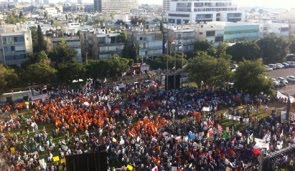
4 August 2011, Haaretz הארץ (Israel)
By Ilan Lior and Ravital Hovel
More than 1,000 parents participated Thursday in stroller marches across Israel, with about 500 in Tel Aviv, 400 in Hertzliya, 200 in Kiryat Motzkin, near Haifa, and about 50 in Sderot, all protesting against the high cost of raising children in Israel.
Meanwhile, a protest took place outside the Histadrut headquarters in Tel Aviv, where Histadrut Labor Federation Chairman Ofer Eini and the head of the workers' committee presented speeches to demonstrators. Youth groups, together with representatives of the National Union of Israeli Students, also participated in the rally.
Elsewhere in Tel Aviv, about 1,500 university lecturers, students, teachers and youth group leaders marched on Rothschild Boulevard. They made their way to the house of Education Minister Gideon Sa'ar, calling out, "Free education for all."
The Tel Aviv stroller march headed to Gan Meir, where marchers were set to hold a rally. Despite the turnout of about 500 parents and children, this number did not meet the expectations of the protest's organizers, who predicted thousands would attend.
Yael Barda, one of the stroller march's organizers rejected claims by Eini and members of the Treasury, in which they said the demand for free education for children aged 10 and over is unreasonable. "We suggest the Treasury sits back down in front of their laptops and recalculates, because we aren't going anywhere," she said.
Barda called upon the protesters to continue taking to the streets and demonstrating against the cost of living in Israel. "We've held back for a long time with all the cynicism we have for Treasury clerks and the Israeli government. They have buried all the social laws over the last 20 years. We are not cynical. We have dreams and we are going to change this country," she said.
At the stroller marches, parents called out "The people demand social justice," "Let's show the government just who's dragging the trolley," and "We won't give up, reduce the prices."
Hundreds of parents and children also began marching from Hatotach Square in Kiryat Motszkin, near Haifa, and blocked the road, with police permission.
Israelis take tent protest to the White House
Israel's housing reform law explained
quarta-feira, 3 de agosto de 2011
Israel Economic Protests: What Game is Being Changed?
1 August 2011, Shalom Rav http://rabbibrant.com (USA)
by Rabbi Brant Rosen
This past April, the Forward reported:
(The Organization for Economic Cooperation and Development) has reported that poverty is almost twice as widespread in Israel, 19.9% of the population, compared to the OECD average, 10.9%. The gap between the overall standard of living in Israel and that of the lowest tenth of the population was three times higher than the OECD average. In its latest release of data, made public April 12, the OECD reported that 39% of Israelis find it “difficult” or “very difficult” to live on their current incomes, well above the OECD average of 24%.
Those stats might explain this more recent news out of Israel:
More than 150,000 protesters took to the streets in 12 Israeli cities, calling for a change in the division of wealth and the resignation of Prime Minister Benjamin Netanyahu.
In Tel Aviv, an estimated 100,000 protesters marched from Habima Square to the Tel Aviv Museum. “We are happy to see the people of Israel taking to the streets, each in their own city, each with their own troubles, but many troubles that are common to all of us,” said one of the organizers, Yonatan Levy.
This one is a game changer, no question, but the jury is still out on how much it might eventually change, or what the game even is. Indeed, as Dahlia Scheindlin and Joseph Dana have just reported in +972:
Every grievance is coming out: there are slogans against the huge concentration of the country’s wealth into the hands of a very few, slogans raging against enormous economic gaps between rich and poor in Israel, lists of demands for just resource distribution and for various elements of a welfare state, salary hikes and lower costs, better education conditions and health care; against the national housing committees law, against the government, for Tahrir. At 10pm on Friday night, when a song group spontaneously burst into chants of “The people! Want! Social Justice!” one young woman sang out beatifically, “The people! Want! All Sorts of Things!”
It’s also notable that one critical cause of this economic disparity is glaringly absent from the protesters’ concern, as Aziz Abu Sarah noted last week:
What amazes me is many Israelis’ inability to make the connection between the continuation of the occupation and the domestic problems Israel faces today; Israel is building constantly in the West Bank but it is failing to provide housing to its citizens within Israel proper. The current Israeli government’s focus on improving living standards in settlements while failing to do the same for the rest of the country is a moral failure.
According to a Peace Now report published on July 20, settlers in the West Bank receive 69 percent discount on the value of the land (so that buyers have to pay only 31 percent of the price of the land) and 50 percent funding of the development costs of the building project. In 2009 Israel investment of settlements public building (excluding East Jerusalem) was 431 million shekels, which was 15.36 percent of all public investment in construction for housing that year, despite the fact that they compose only 4 percent of the residents of Israel.
Scheindlin/Dana drive this critical point home in their article as well:
On Friday, some protesters hassled other Palestinian protesters, citizens suffering from housing crises. It came to scuffles. The diminutive Palestinian flags they hung were removed. Joseph recalls the struggles against apartheid in South Africa and Jim Crow south. Can we imagine the ruling classes there demanding “social justice” without addressing their gravest internal injustices? What does the term “social justice” mean if so many who don’t have it are left out? Sure, let’s protest exorbitant housing costs – but why call it “social justice” if the very crux of social justice, namely equality, is not addressed? Can Israelis have a social justice revolution without speaking about the rights of people they control and occupy?
The remarkable power of these grassroots protests is undeniable – but just how far it goes in shifting power still remains to be seen.
(While we wait, however, at least we can enjoy this great mix by Israeli viral video satirist Noy Alooshe – see above…)
(Shalom 1492: To see the video: http://rabbibrant.com)
Israelis respond to new housing law: Protests and more protests
3 August 2011, Haaretz הארץ (Israel)
Leaders of protest movement criticize passage of controversial housing law; demonstrations planned for Thursday and Saturday.
By Ilan Lior, Gili Cohen and Haaretz
Leaders of the housing protest movement that has been gaining momentum across Israel in recent weeks criticized Prime Minister Benjamin Netanyahu's government on Wednesday following the passage of a controversial housing bill that will set up national committees to approve new housing projects.
Protesters are planning large demonstrations on Thursday and Saturday.
The chairman of the National Students Union, Itzik Shmuli, said that the government's approval of the hosuing law "defied the public and choked the chance for trust and dialogue".
The Dror Yisrael movement said, "As we gathered to formulate our positions for dialogue with the government, we received a resounding slap from Netanyahu and his government. It seems that the prime minister's statement on establishing a team for dialogue with us was merely a facade or an attempt to dismantle opposition with sweet talk."
The Kadima party said in response to the passage of the law that, "The most bloated government in the history of Israel has proven that it is also the most opaque in the history of Israel. Government ministers speak of the close attention they are paying to the public protest but spit on them from the Knesset."
Protesters on Wednesday blocked roads in Tel Aviv, Jerusalem, Be'er Sheva and Kiryat Shmona. New protest tents were established in Tiberias and Taibeh.
More on this topic
Knesset approves controversial housing bill over protest leaders' objections
Leaders of protest movement criticize passage of controversial housing law; demonstrations planned for Thursday and Saturday.
By Ilan Lior, Gili Cohen and Haaretz
Leaders of the housing protest movement that has been gaining momentum across Israel in recent weeks criticized Prime Minister Benjamin Netanyahu's government on Wednesday following the passage of a controversial housing bill that will set up national committees to approve new housing projects.
Protesters are planning large demonstrations on Thursday and Saturday.
The chairman of the National Students Union, Itzik Shmuli, said that the government's approval of the hosuing law "defied the public and choked the chance for trust and dialogue".
The Dror Yisrael movement said, "As we gathered to formulate our positions for dialogue with the government, we received a resounding slap from Netanyahu and his government. It seems that the prime minister's statement on establishing a team for dialogue with us was merely a facade or an attempt to dismantle opposition with sweet talk."
The Kadima party said in response to the passage of the law that, "The most bloated government in the history of Israel has proven that it is also the most opaque in the history of Israel. Government ministers speak of the close attention they are paying to the public protest but spit on them from the Knesset."
Protesters on Wednesday blocked roads in Tel Aviv, Jerusalem, Be'er Sheva and Kiryat Shmona. New protest tents were established in Tiberias and Taibeh.
Knesset approves controversial housing bill over protest leaders' objections
segunda-feira, 1 de agosto de 2011
Jewish, Arab workers and youth protest against social conditions in Israel
By Patrick O’Connor
1 August 2011, World Socialist Web Site http://www.wsws.org (Australia)
An estimated 150,000 mostly young people in Israel, both Jewish and Arab, protested Saturday over spiralling living costs and the economic and social policies of Prime Minister Benjamin Netanyahu.
The demonstrations—held in eleven cities, with the largest in Tel Aviv, Jerusalem and Haifa—mark a significant development in the “tent city” movement against high housing costs launched by students nearly three weeks ago. With a total population of about 7 million, 150,000 people represents a large percentage of the country.
While still in its early stages, a movement within the Israeli working class is being driven by worsening social inequality, economic hardship, and enormous anger with the Netanyahu government and the existing political setup in the country.
Yediot Aharonot columnist Nahum Barnea described the protests as unprecedented. “Whether the crowds numbered 100,000 or 200,000, never have such numbers descended into the streets over social issues,” he wrote. “Who would have believed that 150,000 Israelis would take the trouble to go out into the street in the name of social change… the alienation and cynicism that typified the public in the past number of years has now been replaced by involvement and protest.”
The largest protest was in Tel Aviv, where up to 100,000 people marched through the city centre. According to media reports, another 10,000 rallied in Jerusalem outside the prime minister’s residence and 8,000 marched in Haifa. A smaller demonstration in central Nazareth involved both Jews and Arabs, the first such joint rally since the housing protests began.
Slogans included: “The people demand social justice”, “We want justice, not charity”, and “When the government is against the people, the people are against the government”. Protestors also made banners pointing to the influence of the recent uprisings in Egypt and other Arab countries. One read: “This is the Israeli spring”, and another, “Mubarak, Assad, Netanyahu!”
One young person was asked by the RT news network whether the protests had been inspired by events in Arab countries. He replied, “There is a lot of influence of what happened in Tahrir Square… There’s a lot of influence of course. That’s when people understand that they have the power, that they can organise by themselves, they don’t need any more the government to tell them what to do, they can start telling the government what they want.”
These developments presage a major shift within the Zionist state. Amid a worsening global economic breakdown, the social crisis in Israel is laying bare the objective potential for unifying Jewish workers with their Arab brothers and sisters both within Israel and throughout the Middle East. Opening up is a new path of political and social struggle, in opposition to the Zionist ruling elite, the Arab bourgeoisie and their imperialist backers—on the basis of common class interest, not nationality, race or religious identity.
Wider layers of the Israeli population are being drawn into the protest movement. Prominent musicians and writers have joined the demonstrations. Yesterday about 1,000 parents and their young children participated in a “strollers’ march” in Jerusalem and Haifa to protest against excessive day care centre costs and inadequate parental leave provisions.
A strike of public hospital medical professionals is in its fifth month. On Sunday, hundreds of doctors, medical residents and hospital interns protested near the Knesset (parliament) demanding adequate funding for the public health system.
Today, local authority workers are set to strike in support of the antigovernment protests, shutting down public offices and leaving rubbish uncollected.
The Netanyahu government has been plunged into crisis. A comment published by Ynet News columnist Attila Somfalvi noted: “Some 150,000 people who left their homes yesterday directed their fury at the man who they view as the culprit behind the State’s privatisation and burial of concern for the regular folk. These are not a bunch of ‘spoiled brats’ who can be dismissed with a disparaging hand gesture or by rolling one’s eyes; these are working people; angry people facing collapse... This protest is making its way to the top of the government, shakes up Likud, rocks the leather chairs in the Knesset and makes the prime minister and finance minister sweat and seek an escape route from the fury pouring into the street.”
The Shas party, which represents ultra-orthodox Jews and has 11 of the 120 seats in the Knesset, has warned it may withdraw from Netanyahu’s coalition government, potentially triggering new elections.
The prime minister has rushed to try to defuse the protest movement. Immediately after Saturday’s demonstrations Netanyahu called a cabinet meeting and announced that a “special team” of ministers and experts would listen to the protest leaders and submit a plan to “alleviate Israelis’ economic burden”. He declared: “We are all aware of the genuine hardship of the cost of living in Israel… we must deal with the genuine distress, seriously and responsibly. This, without a doubt, compels us to change our list of priorities.”
This hollow rhetoric has been accompanied by various sops in response to the protestors’ demands. Last Tuesday, Netanyahu promised to build 50,000 units of housing within 18 months. The government yesterday announced that the excise tax on petrol is to be lowered for one month, during August, and that some elderly people will have their home heating grant doubled. The prime minister has also suggested that he hopes to cut taxes and water charges.
At the same time, Netanyahu has made clear that there will be no serious concessions to the social demands of the protesting workers and youth. “We must avoid irresponsible, hasty and populist steps that are liable to cause the country to deteriorate into the situation of certain European countries, which are on the verge of bankruptcy and large-scale unemployment,” he declared.
Finance minister and senior Likud member Yuval Steinitz raised the spectre of state bankruptcy even more sharply. “We see the talk about the debt crisis in Europe,” he said. “We are even hearing talk of a possible default in the United States. My supreme duty is to ensure we do not reach this situation in the State of Israel... we will not turn the rich and the business people and the investors and the industrialists into the enemies of the people, because they are part of a healthy economy.”
The financial markets are clearly bringing enormous pressure to bear on the Netanyahu government, urging a continuation of pro-business policies irrespective of mass opposition. The value of Israeli government bonds declined after the weekend’s rallies. “Growing protests over rising prices increase pressure on the government to act,” Tel Aviv bond trader Ehud Itzhakov told Bloomberg. “There is concern in the market the government may need to raise more debt, which is creating uncertainty about the deficit.”
The Israeli Treasury Department is reportedly outraged over the government’s limited spending announcements in response to the protests. The director general of Israel’s finance ministry, Haim Shani, resigned yesterday. He cited “differences of opinion in fundamental issues” with the finance minister, adding that “events of the past few days have exacerbated the problems.”
It remains to be seen how the Netanyahu government responds to the crisis in the next days and weeks, but there is a real danger that a provocation will be launched against the Palestinian people or neighbouring Arab states as a diversion. Education Minister Gideon Sa’ar reportedly advised his Likud faction colleagues last week that every election in Israel that has “revolved around a socio-economic issue, Likud lost”, whereas when the main issues were “security related, Likud won.”
The author also recommends:
The Israeli protests and the unity of Arab and Jewish workers [30 July 2011]
Assinar:
Postagens (Atom)